FEATURES
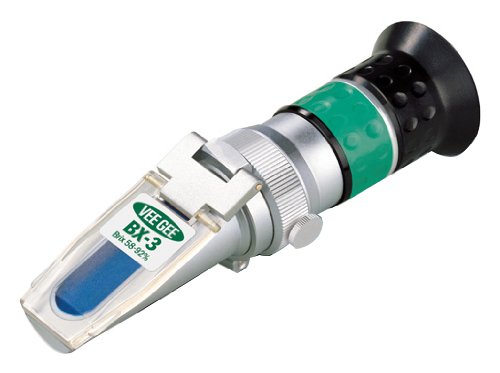
- Handheld portable refractometer for Brix (58.0 to 92.0%) measurement of sugar content in jams, jellies, marmalades, malt, honey, and maple syrup
- Manual temperature compensation and calibrated with a liquid standard using a tool-free calibration ring
- Ambient light illuminates the scale; no additional power source is required
- Durable metal and rubber outer shell with a telescope-shaped, streamlined design (40 x 40 x 140mm), a rubber grip to guard against hand heat for accurate measurements, and a non-roll stand to protect against damage
- Optical glass prism mounted in all-metal housing for quick temperature equilibrium between sample and prism
SPECIFICATION
| Model No. | BX-3 |
| Product Size | With Brix Scale, 58-92%, +/-0.2% Accuracy, 0.20% Resolution |
| Package Dimension | 7.87 x 5.59 x 20.07 Cm |
| Package Weight | 0.32 ~ 0.38 Kg |
| Product Group | BISS |
| Availability | Available (Usually ships in 1-4 business days) |
DESCRIPTION
| Measurement scale range | Brix 58.0 to 92.0% |
| Accuracy | + or - 0.2% |
| Resolution | 0.2% |
| Ambient temperature for unit operation | 10 to 30 degrees C |
| Sample volume | > 0.1ml |
| Measurement time | Instantaneous |
| Body type | Copper alloy with a nickel-chrome coating |
| Illumination | Ambient light; unit requires no additional power source |
| Dimensions | 40 x 40 x 140mm (H x W x D) |
| Weight | 230g |
| Warranty | One year |
H is height, the vertical distance from the lowest to highest point; W is width, the horizontal distance from left to right; D is depth, the horizontal distance from front to back.
Refractometers are used to determine substance content in a sample, to provide unit readings of substances including Brix, salinity, and alcohol; to detect chemical impurities, or to measure components of samples such as industrial fluid. Refractometers measure the refractive index of a substance, which is its optical characteristic, and the number of dissolved particles in it. The refractive index is the ratio of the speed of light in empty space to the speed of light in a substance; when light passes from one medium to another. Generally, a low concentration sample has a larger angle of refraction than a high concentration sample. For example, a straw placed in a high-concentration substance appears more bent than when placed in a low-concentration substance. Refractometers can work with natural light, or with an external power source such as batteries or electricity. They typically have either a digital or analog reading display, though some units utilize both types. Some analog-display refractometers can be used for both solids and liquids. Digital-display refractometers are used exclusively for liquids. Types of refractometers include handheld, benchtop, and in-process. Handheld refractometers are elongated and telescope-shaped, or shorter and rectangular. Analog handheld refractometer readings are obtained by looking through the monocular eyepiece and viewing where the boundary line intersects with the memory line. Digital handheld models provide a digital readout. Benchtop refractometers typically measure with a higher degree of accuracy than handheld units. In-process refractometers are used for continuous process monitoring and data readouts, and are generally fitted into a piping system for ongoing analysis. Refractometers are used in a wide variety of applications in the culinary, food and beverage, pharmaceutical, educational, geological, chemical, ecological, and automotive industries, and for water-testing applications.
VEE GEE Scientific manufactures laboratory equipment and supplies, and makes the VanGuard brand of products. The company, founded in 1981 and headquartered in Kirkland, WA, offers scientific equipment for educational, research, clinical, and industrial applications.
What’s in the Box?
- BX-3 refractometer
- Vinyl carrying case
- Plastic transfer pipet
- Instructions