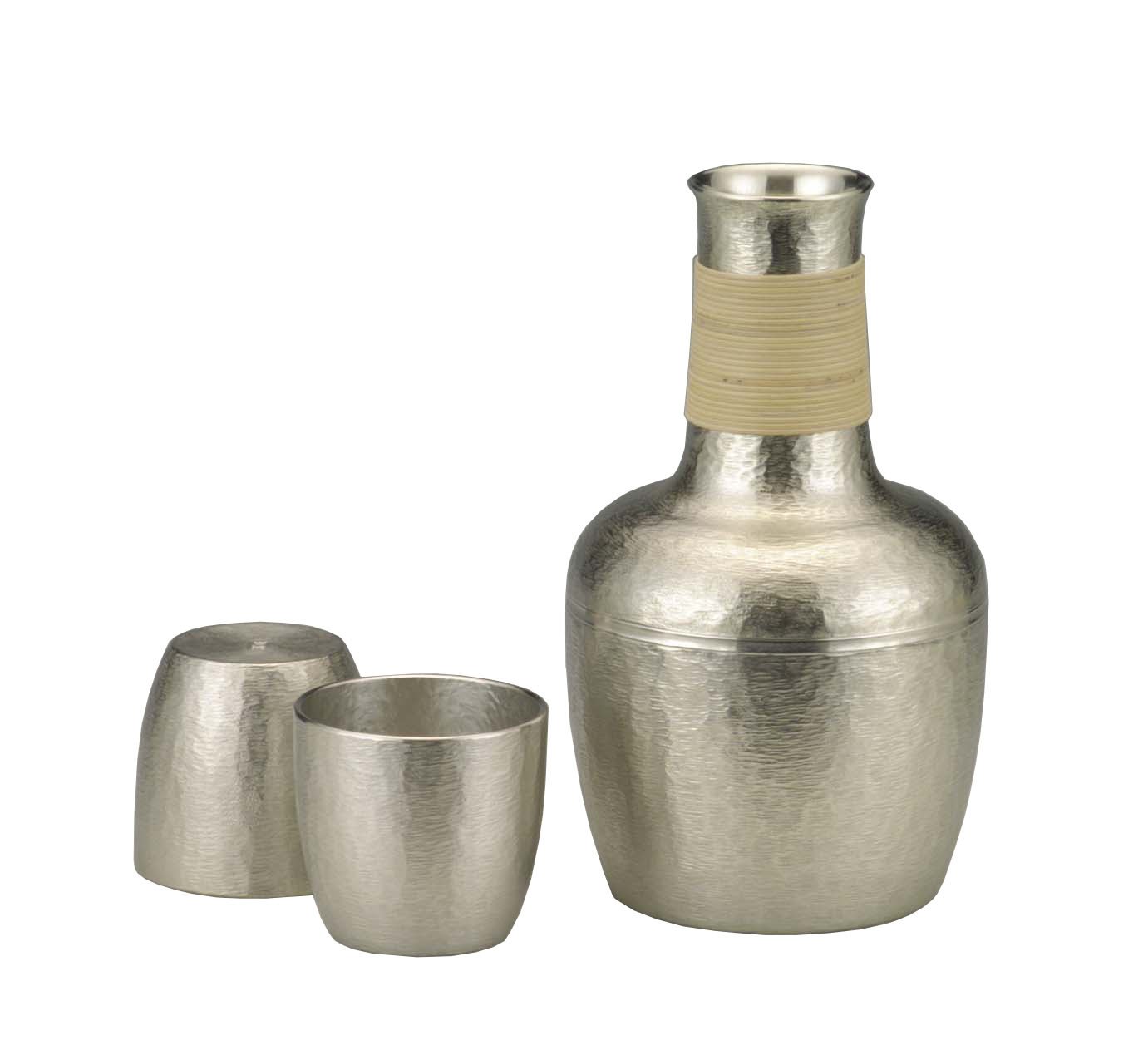
Item Descriptions:
The history of the tin instrument in Japan is said to have been found tin water pot from the ruins of the ancient city of the Egyptian dynasty long ago, 1500 BC.
Tin's distinctive luster and low melting point properties have been used for the manufacture of appliances etc. in various countries all over the world.
In Japan in the 7th - 9th centuries, a few points have been preserved in Nara Shosoin which is famous as a treasure trove, coming from the envoy of envoys and envoys.
Since ancient times, tea pots, tea ceremonies, etc. were mainly produced around God Buddhist equipments such as Shinku Tokutari, Sakakibashi etc., and it was loved by a few people such as the Imperial Palace, but in the Edo period it became widely used in general
It was.
With advances in technology, we have become able to produce all kinds of instruments such as alcoholic beverages, teaware, tableware, accessories etc, and we have received patronage as gifts for generous household dishes, as well as advances, gifts and souvenirs.
Characteristics of the tin instrument
Tin usually does not rust or discolor.
Depending on your care, warm gloss and gloss can be enjoyed forever.
It is said that molecules of tin adsorb coarse impurities of water and alcohol, mellow taste.
Also, it is harmless and has no metallic odor, it has been used as a dishware material since ancient times.
The technology of "Osaka tin equipment" emanated to the first Iei (Tin I) which flows Kyotin spread from Kyoto to Osaka in the latter half of the Edo period, and prospered in Osaka prosperously for generations.
After that, in order to rebuild the tin industry in Osaka, which was devastated by World War II, the craftworkers who gathered the flow of each workshop of Imai family, Sano family, Tanaka family, Nakaya family, Ichimura family gathered
, Founded Osaka Tin Equipment Co., Ltd. in 1954, and has reached today.
The one we make is expensive if it is "just to do" and may be familiar to say "unusual".
However, they are made carefully one by one based on the belief that "it is beautiful and more practical" that has been refined over the course of several hundred years.
By continuing to use it with the month and day rather than being temporarily pandemic, the depth will increase and its value will be raised.
It is also recommended for gifts and presents.
How to Care
After using, wash with lukewarm water and mild detergent, rinse well, please drain off the moisture or tumble.
Tin is mainly molded and polished using Rosso.
Please wipe gently with dust and soft cloth along the circumference.
When a stain is severe or lightly discolored, wear a neutral detergent or baking soda on a worn-out sponge, please wash evenly along the circumference somewhat strongly.
Most stains can be taken in this way.
(However, since there is a fear that Ibushi will peel off when using the sponge for the product of Ibush, please wipe off the dirt with a detergent and a soft cloth.)
Usage notes
Usage notes
Please pay attention to the following points on using the tin equipment.
As a main feature of the tin instrument, the tin instrument is a soft metal, so there is a possibility of nail scratches, or dropping it may be dented.
Because it has high thermal conductivity, it can not hold it if hot things are put in it.
Avoid strongly acidic drinks (lemon water etc.) that may discolor.
Please do not keep it in the freezer of the refrigerator.
Crystal structure changes (Supesuto) There is a case where the main body easily collapses.
Use of dishwasher / microwave is not available.
Tin machines are still carefully made one by one with traditional production methods.
There is a product that takes time when out of stock.
Features:
- Size: (approx) φ 8.0 × H 14 cm / Swallowing φ 4.7 × H 4.3 cm
- Body weight: 640 g
- Material · Material: Tin (over 97%)
- Producing country: Japan
- There was amendment of the Food Sanitation Law from the Ministry of Health and Welfare in FY 2008, all the tin instruments currently being manufactured are safe products within the revised standard value.
Product information:
Shipping Weight: 943 g
Package Dimensions: 10.59 x 17.20 x 17.91 cm
SHIPPING METHOD
Delivered directly from Japan by Japan Post. It will take 3 to 5 business days to prepare the order for shipping. We guarantee careful packing and safe shipping.Please note that in some cases additional import or VAT charges may incur and have to be borne by the client.
1. Japanpost registered mail
Shipment by Japanpost Registered Mail (Standard). Trackable any time with tracking number. Insurance is not available. Delivery time usually is between 1-3 weeks from the date of dispatch. Some items are not eligible for Standard Shipping.
2. Qxpress Standard
Shipment by Qxpress standard service. Trackable at any time with tracking number. Registered and insured up to a value of item price and shipping fees.Delivery time is usually between 5-10 business days from the date of dispatch.
3. EMS
Shipment by Expedited Mail Service. Trackable at any time with tracking number. Registered and insured up to a value of $200 and usually delivered in 2-6 business day from the date of dispatch.

| Japanpost registered mail | Qexpress | EMS | |
|---|---|---|---|
| Shipping Method | Japanpost Registered Mail (Standard) | Standard Qexpress | EMS (Expedited Mail Service) |
| Trackable | Yes | Yes | Yes |
| Insured | N/A | Yes (Up to item price and shipping fees) | Yes (Up to $200.00) |
| Asia | 1-3 weeks | 5-10 days | 2-5 days |
| Oceania; North America; Central America and the Middle East | 2-4 weeks | 6-14 days | 2-6 days |
| Europe | 2-4 weeks | 6-16 days | 3-8 days |
| South America and Africa | 2-4 weeks | 10-18 days | 4-8 days |
NOTICE:
- For overseas delivery, please be aware that damage to the outer box can be seen.
- If you would like to avoid as much damage as possible, please choose the EMS shipping method.
"According to Qoo10 guide line,overseas shipping fees will be charged to you extra if you choose Qxpress standard shipping.We recommend you to compare the total price of your purchase with EMS."
