
Dutchman's Gold Bee Pollen

Super Premium 100% Canadian Bee Pollen
The Super Premium 100% Canadian Bee Pollen is produced in the pristine Peace River area of Alberta Canada. This is a premium bee pollen with excellent color, taste, texture and nutrient levels. There is very limited supply of this bee pollen as it is sourced from one beekeeper - we are not able to obtain as much of it as we require due to the high demand for Canadian bee pollen and when we run out of our supply, it will be unavailable until the proceeding Fall.


CLICK ON BEE TO PLAY VIDEO

What Is Pollen?
Pollen is the male seed of flowers. It is required for the fertilization of the plant. The tiny particles consist of 50/1,000-millimeter corpuscles, formed at the free end of the stamen in the heart of the blossom. Every variety of flower in the universe puts forth a dusting of pollen. Many orchard fruits and agricultural food crops do, too.
Bee pollen is the food of the young bee and it is approximately 40% protein. It is considered one of nature's most completely nourishing foods. It contains nearly all nutrients required by humans. About half of its protein is in the form of free amino acids that are ready to be used directly by the body. Such highly assimilable protein can contribute significantly to one's protein needs.
Gathering pollen is not as easy as it sounds. Once a honeybee arrives at a flower, she settles herself in and nimbly scrapes off the powdery loose pollen from the stamen with her jaws and front legs, moistening it with a dab of the honey she brought with her from the hive. The enlarged and broadened tarsal segments of her legs have a thick trimming of bristles, called pollen combs. The bee uses these combs to brush the gold powder from her coat and legs in mid-flight. With a skillful pressing movement of her auricle, which is used as a hammer, she pushes the gathered gold into her baskets. Her pollen baskets, surrounded by a fringe of long hairs, are simply concave areas located on the outside of her tibias. When the bee's baskets are fully loaded, the microscopic golden dust has been tamped down into a single golden grain, or granule.
One of the most interesting facts about bee pollen is that it cannot be synthesized in a laboratory. When researchers take away a bee's pollen-filled comb and feed her manmade pollen, the bee dies even though all the known nutrients are present in the lab-produced synthesized food. Many thousands of chemical analyses of bee pollen have been made with the very latest diagnostic equipment, but there are still some elements present in bee pollen that science cannot identify. The bees add some mysterious "extra" of their own. These unidentifiable elements may very well be the reason bee pollen works so spectacularly against so many diverse conditions of ill health.
Honeybees do double duty. They are programmed to gather pollen and carry it back to the hive as food for the colony. However, even more important as far as humans are concerned, they are also responsible for the pollination of more than 80 percent of green growing things. As bees buzz from blossom to blossom, microscopic pollen particles coat their stubby little bodies so densely that they sometimes look like little yellow fuzz balls. When they arrive at the next flower, a portion of the live golden dust is transferred to that blossom and pollination is accomplished.
It is important to recognize that a one teaspoon dose of pollen takes one bee working eight hours a day for one month to gather. Each bee pollen pelletcontains over two million flower pollen grains and one teaspoonful contains over 2.5 billion grains of flower pollen.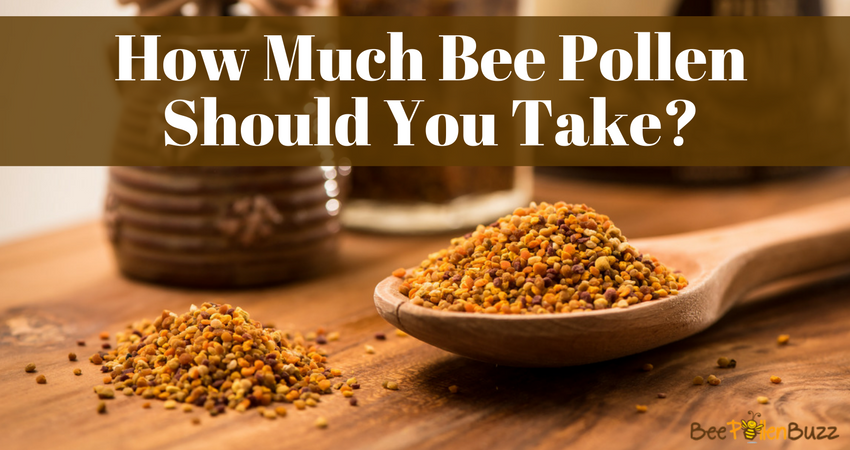
The correct dose of bee pollen for you will depend on several factors; what form of pollen you're planning on taking (capsules or granules), the reason you're taking bee pollen and lastly, if you've ever taken it before. Over the years I've witnessed effective doses ranging from a few granules a day all the way up to extreme amounts as high as two cups daily. You'll want to experiment with bee pollen to find the minimum amount you need to take to obtain the maximum benefits.
It is Important to Start Small
If you've never taken bee pollen before, it is important to start out with a small, conservative amount regardless of the form you're taking, and work up to your daily dose, whatever that amount may be.
If you are taking bee pollen granules, begin with 1 or 2 granules on day one. Place them under their tongue and let dissolve or simply chew them. If you experience no reaction, double the amount of granules you consume on day two. Continue this for at least a week.
If you are using a capsule, you'll need to twist open the capsule and dump a very small amount of the powder out. I suggest mixing it in juice, water or your favorite beverage. Apple sauce, honey, granola or cereal also work well. On day two, slightly increase the amount you remove from the capsule. Again, do this for at least a week while you build tolerance.
General Bee Pollen Dosage Guidelines
Once you've determined that you tolerate bee pollen well, you can begin taking a full dose on a daily basis.
Granules:
- For general health purposes, my recommended bee pollen dosage is 1 - 2 heaping teaspoons of the raw granules per day. Mix them in juice, a smoothie, yogurt, apple sauce, cereal or simply chew them and swallow.
Capsules:
- For general health purposes, my recommended bee pollen dosage is 1000 mg - 2000 mg per day taken with water or juice.
If you are treating a specific health condition or concern, you may wish to take larger amounts of bee pollen daily than those listed for general health.
Below I've made specific bee pollen dosage recommendations for more specific conditions.
Bee Pollen Dosage for Allergies
Allergies are a tricky thing. My husband Mark has battled with seasonal allergies for most of his life. As he will tell you, adding bee pollen and other bee products helped him more than any other product out there.
More than Claritin. More than Allegra. More than allergy shots.
And all without any side effects.
So here are some recommendations and pointers.
- Start with bee pollen early. If you have allergies in June, start taking pollen in January. The longer you give your immune system to adapt to the pollens the better.
- Read this article on bee pollen and allergies. In fact, many people report that their second summer of using pollens is usually much better than their first. Use it continuously through the summer and winter leading into the next allergy season.
- Follow my tolerance test to determine your sensitivity to bee pollen. Especially when dealing with allergies.
- Work your way up to a standard daily dose of 1 tablespoon of raw granules or 2000 mg to 3000 mg in capsule form.
- Consider also taking local, raw honey in addition to bee pollen for your allergies.
Dosage Recommendations for Energy:
- Take one to two tablespoons first thing in the morning with a balanced breakfast. I mix my morning pollen right in with my protein power smoothie. This will ensure clean burning, nutrient rich, balanced energy for the first part of your day.
- Need a quick snack? Take up to a half cup of pollen if you're on the go and need a healthy snack that will leave you feeling full. I find one to two tablespoons in a pinch can hold me for a couple of hours easily.
- Pre-workout energy boost? Take a tablespoon one hour before your workout. Especially if you're trying to lose body fat. I find bee pollen makes me feel quite full despite being very low calorie.
If you're using capsules or tablets, take 3 - 6 thirty minutes before you train. Generally, capsules have been pre-ground so they are easier to digest and are absorbed more rapidly.
Take another tablespoon or 6 - 12 capsules immediately after your workout to stimulate the recovery process.
Bee Pollen for Outstanding Health and Longevity
We're a pill taking society obsessed with living forever. As a result, things like multi-vitamin supplements have had entire industries created around them.
Most multi-vitamins are made in a lab. A lot of companies do a pretty good job. Man-made, synthesized vitamin supplements have been shown to extend life span without question.
But I suspect that you're not interested in just extending your life. If you're like me, you're interested in outstanding health AND longevity. Abundant energy, no need for doctor prescribed chemicals, a powerful immune system and a body that can enjoy life.
That is where bee pollen comes in.
No scientist, no pharmaceutical company, no supplement company has ever developed something that contains over a dozen vitamins, 28 minerals, 11 enzymes and co-enzymes, and 14 fatty acids as well as 10 amino acids. And they likely never will. For the most complete, bio-available, health promoting multi-vitamin and mineral supplement on the planet, try taking a heaping tablespoon of raw bee pollen every morning.
If you're taking capsules, take at least 2000 mg per day.
Bee Pollen Dosage for Athletes
It is common knowledge that the heavy demands of training many athletes put themselves through increases their nutrient requirements to levels much higher than the average sedentary adult.
We also know vitamins and minerals are lost at high rates through sweat as well as through the increased need for anti-oxidants to combat the additional free radicals generated by intense exercise. These facts alone suggest adding bee pollen to an athlete's nutritional regime might be wise.
Here's why.
Bee pollen is 25% protein and contains all the essential amino acids including the critically important Branch Chain Amino Acids. BCAA's just so happen to be your muscles first choice for energy during intense activity. If you're an athlete of any type, you are likely aware of the additional protein requirements you have. Furthermore, if you're an athlete who doesn't tolerate the milk based proteins (whey or casein) that make up most of the protein supplement market today, bee pollen is a perfect fit for you.
Have you tasted hemp or rice or soy protein? Ugggghhh. Despite many advances in flavoring, these vegetable proteins still taste quite....'earthy' to say the least. Bee pollen on the other hand actually tastes quite nice.
Perhaps even more important than the amino acid content of bee pollen are the vitamins and minerals it contains . Like I said earlier, intense exercise generates tremendous amounts of free radicals. Free radicals can only be stopped by anti-oxidants such as Vitamin A, Beta Carotene, Vitamin C, and Vitamin E.
All of these just so happen to be found in bee pollen in a perfectly bio-available state. A state that nature created and can not be duplicated by man in a lab.
As an athlete, you also tend to experience increased sweat loss. Most vitamins and minerals are water soluble. This means that you only need water to absorb them. But it also means that you can and do lose them through sweat. And the more you sweat, the more you lose. So replacing a mineral such as magnesium, which has over 300 duties in the body including helping manage your heart rate, is very important.
Magnesium also aids in proper muscle function.
Raw Granules: up to 2 cups of bee pollen per day. Consume a 1/2 cup one hour before your workout and an additional half or full cup post workout within one hour of completion.
Capsules: up to twelve 500 mg capsules per day. A typical athlete's dosage might be 6 caps 1 hour before a workout and an additional 6 within 1 hour of completing the workout.
If you have a question about how much bee pollen to take for a condition not listed above,
Recommended Bee Pollen Products
There are many bee pollen products on the market, many of which are very poor quality with very suspect ingredients. I regularly get solicited by companies from all over the world selling cheap, low grade bee pollen that is contaminated with antibiotics, heavy metals and other impurities. I use and only recommend Dutchman's Gold Bee Pollen.