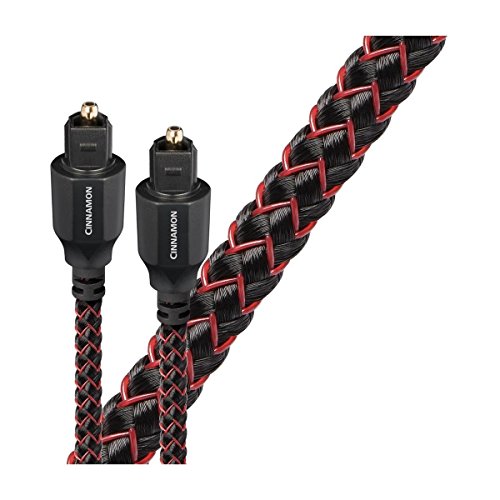
AudioQuest Cinnamon OptiLink 3m (9.84 ft.) Optical Audio Cable[Product Information]- Enter your model numberto make sure this fits.
- The problem is that the dispersed light does get through the cable, but only after it has taken a longer path, like a pool ball bouncing off the side-rails, causing it to arrive later. This delayed part of the signal prevents the computer charged with decoding this information from being able to decode properly, or even at all.
- The inability to decode shows first at higher frequencies (not audio frequencies, this is a mono stream of digital audio informa-tion), so reduced bandwidth is a measurable signature of light being dispersed by a fiber. The punch line: The less dispersion in the fiber, the less distortion in the final analog audio signal presented to our ears.
- There is another serious dispersal mechanism in the Toslink system. The fiber is a relatively huge 1.0mm in diameter, and the LED light source is also relatively large, spraying light into the fiber at many different angles.
- Even if the fiber were absolutely perfect, the signal would be spread across time because light rays entering at different angles take different length paths and arrives with different amounts of delay.
- he almost complete solution to this problem is to use hundreds of much smaller fibers in a 1.0mm bundle. Because each fiber is limited as to what angle of input can enter the fiber, there is far less variety, and far less dispersion over time. This narrow-aperture-effect is similar to how a pin-hole camera can take a picture without a lens ... by letting in light at only a very limited range of angles, a picture can be taken, whereas removing the lens from a wider aperture would make photography impossible.