In THE WORST HARD TIME Timothy Egan put the environmental disaster of the Dust Bowl at the center of a rich history told through characters he brought to indelible life. Now he performs the same alchemy with the Big Burn the largest-ever forest fire in America and the tragedy that cemented Teddy Roosevelt's legacy in the land.
On the afternoon of August 20 1910 a battering ram of wind moved through the drought-stricken national forests of Washington Idaho Montana whipping the hundreds of small blazes burning across the forest floor into a roaring inferno that jumped from treetop to ridge as it raged destroying towns and timber in an eyeblink. Forest rangers had assembled nearly ten thousand men?-- college boys day-workers immigrants from mining camps?-- to fight the fires. But no living person had seen anything like those flames and neither the rangers nor anyone else knew how to subdue them.
Egan narrates the struggles of the overmatched rangers against the implacable fire with unstoppable dramatic force?? through the eyes of the people who lived it. Equally dramatic?? though?? is the larger story he "s of outsized president Teddy Roosevelt and his chief forester Gifford Pinchot. Pioneering the notion of conservation?? Roosevelt and Pinchot did nothing less than create the idea of public land as our national treasure?? owned by every citizen. The robber barons fought him and the rangers charged with protecting the reserves?? but even as TR's national forests were smoldering they were saved: The heroism shown by those same rangers turned public opinion permanently in favor of the forests???though it changed the mission of the forest service with consequences felt in the fires of today.
THE BIG BURN tells an epic story?? paints a moving portrait of the people who lived it?? and offers a critical cautionary tale for our time.
Nearly a hundred years ago?? a big piece of Rocky Mountain high country fell to a fire that has never been matched--in size?? ferocity?? or how it changed the country. I was drawn to this fire in part because of its mythic status among my fellow Westerners. But I was reluctant to try and tell this story because everyone who had lived through it had gone to their grave. With The Worst Hard Time?? I could look into the eyes of people who survived the Dust Bowl and hear their stories--firsthand. They were happy to pass them on"as the baton.
With The Big Burn?? the stories would have to come from ghosts. That fire burned 3 million acres and five towns to the ground in the hot sweep of a single weekend. It also killed nearly a hundred people. So?? my task was to listen to the dead--those Italian and Irish immigrant firefighters in their letters home?? those first forest rangers in memories collected in volumes stashed away in mountain towns?? and in the notes and diaries of two great men who founded the Forest Service. One?? Teddy Roosevelt?? is a voice that lives nearly as loud today as when he bestrode the world stage. The other?? Gifford Pinchot?? was less known?? but his legacy?? like that of Roosevelt?? is everywhere in the public land that Americans now claim as a birthright. And what??s more?? Pinchot himself was married to a ghost for nearly 20 years?? one of the more fascinating things I found in the haunt of the Big Burn.
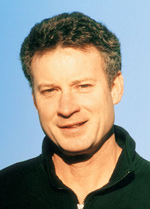
(Photo ? Sophie Egan)
Photographs from The Big Burn
(Click to Enlarge)
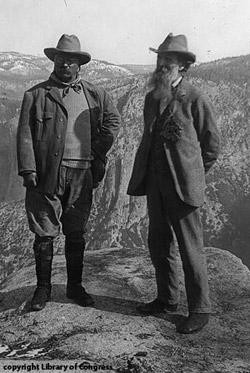 | 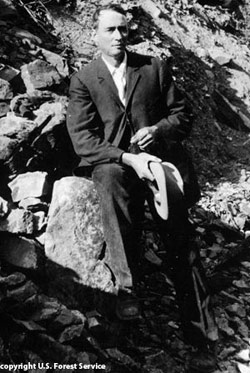 | 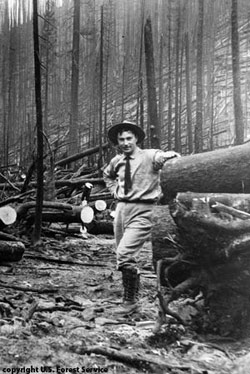 |
| President Theodore Roosevelt and John Muir atop Glacier Point in Yosemite National Park | Ranger Ed Pulaski?? whose actions saved many lives | Ranger Joe Halm after the fire. Like Ranger Pulaski?? he helped save many lives |
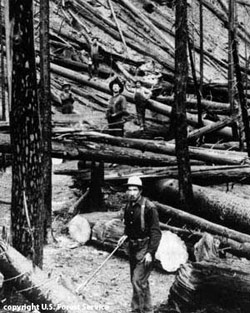 | 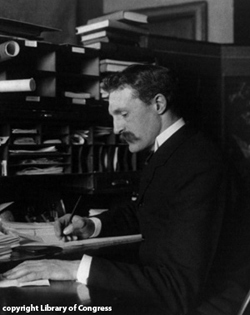 | 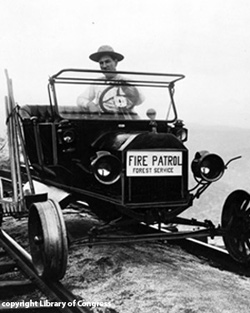 |
| Men standing amid downed timber after the Big Burn of 1910 | Young Gifford Pinchot?? a close friend and personal aide of Roosevelt??s and the first Chief of the U.S. Forest Service | A ForestService fire patrol in 1914 |
A Q&A with Timothy Egan
Q: Tell us something about that great fire. A: Well it was the largest wildfire in American history based on size. In less than two days it torched more than three million acres burned five towns to the ground and killed nearly one hundred people. Q: Wow. How big is three million acres? A: Imagine if the entire state of Connecticut burned in a weekend--that's what you have here. Q: And yet in your subtitle you call this the fire that saved America. A: That's right. This happened in August 1910--next year will be the one hundredth anniversary. It came just after Teddy Roosevelt had left office and left a legacy of public land nearly the size of France. But after Roosevelt was gone from Washington in 1909 the Forest Service the stewards of his legacy came under attack. Gilded Age money wanted the rangers gone the land placed in private hands. Enemies in Congress were constantly sniping at the young agency. And people out west were suspicious of the value of ??Teddy's green rangers???? as they called them. They thought they were all college boys?? softies?? city kids. Q: So how did the fire change that image? A: It made heroes--almost mythic heroes--of the young men who led platoons of firefighters into a sea of flames. The government had marshaled ten thousand people?? an army of young men?? immigrants?? and volunteers?? to fight the fire. It was the first large-scale effort to battle a wildfire in U.S. history. The big-city daily newspapers here and abroad covered it like a war. The firefighters failed?? because the Big Burn was so big and moved so quickly. But they succeeded in one r