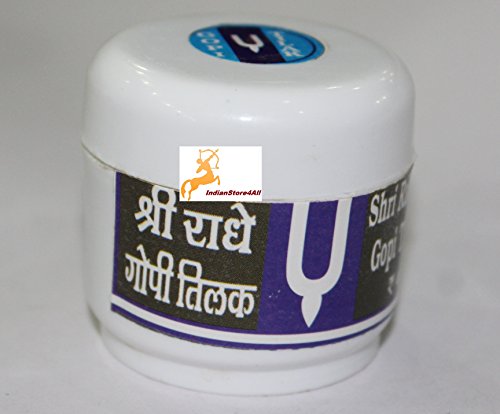
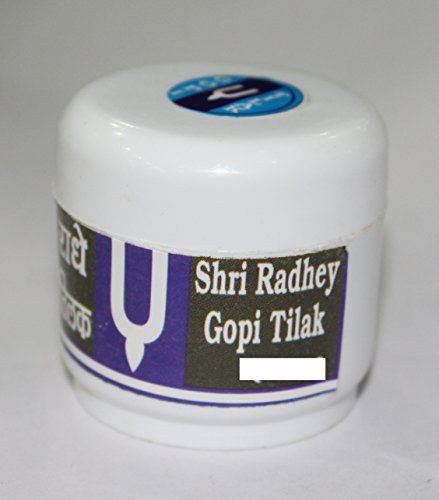
IndianStore4All Shri Radhey Gopi Tilak Chandan Tika
[Product Information]
- This compilation of information will explain what tilak is and why it is worn. As anyone who is familiar with the Vedic tradition knows, many of its followers wear marking on the foreheads. This is called tilak.
- Some tilak markings are made with ash, some with clay or soil, some are red dots with kum kum, or dyed rice flour, or red dots with additional applications like a few grains of rice stuck to it. Some tilak appears as three lines of ash going horizontally across the forehead that indicates one is a Shaivite.
- The Tripuṇḍra tilak, three horizontal lines, on the forehead as well as other body parts are symbols during rites of passages, and for some a daily practice. These lines, states Antonio Rigopoulos, represent Shiva’s threefold power of will (icchāśakti), knowledge (jñānaśakti), and action (kriyāśakti).
- The Tripuṇḍra described in this and other Shaiva texts also symbolizes Shiva’s trident (triśūla) and the divine triad of Brahmā, Vishnu, and Shiva,
- Another form of tilak is the small triangle on the nose with a "V" shape rising vertically up on the forehead from between the eyebrows, which indicates one is a Vaishnava. This is a sign of the foot of Lord Vishnu, recited while chanting the name of Lord Vishnu. This is the one we will primary look at.