


How to spot a Fake 18650 Battery?

How to spot a Fake 18650 Battery?


NITECORE UM10
UM10 USB CHARGER-YouTube
https://youtu.be/UgIUa7Qz9mc
NEW NITECORE i1 
NEW NITECORE i4 

NEW NITECORE i2 

NITECORE D4 EU EU PACKAGING

NITECORE D2 EU EU PACKAGING
DIFFERENCE PACKAGING SAME SPECIFICATION 


18650 battery same size as AA battery?
So what do these 18650 or 26650 mean?
18650 battery is different size from AA battery and they are also different types of battery.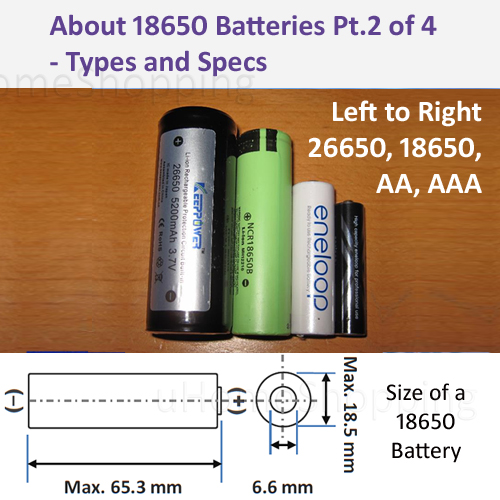
For Li-ion battery;
18 - The first two digits "18" stand for the battery diameter in millimeters. In this case width of the battery is 18mm (millimeters).
65 - The third, and fourth digit stand for length in millimeters. That would be 65mm.
0 - For simplicity just forget about the last digit zero for now.
So what is a 16340 battery?
16mm - diameter
34mm – length
Check here for various battery sizes;
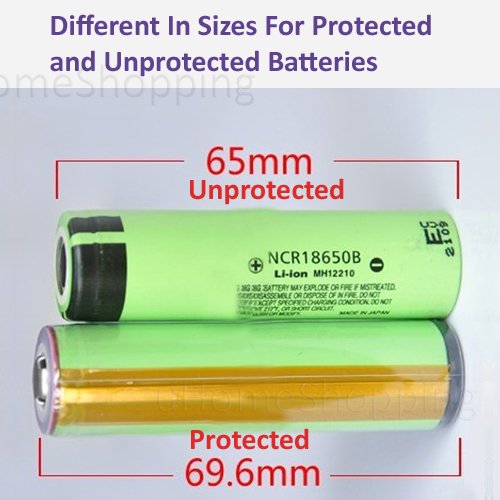
These are the measurements for BARE Li-ion batteries which are also called "Unprotected” or "Flat Top”. If it is "Protected”, that means external protection circuit board is added to the bottom of the battery, and flat wire to the side of it. This will increase the length of the battery by 2.5 to 3mm and the width may be 0.5mm wider.
Protected vs Unprotected Battery;
There is some misunderstanding that a protected battery is safer for high drain use as it prevents you from over-drawing your battery and prevent it to explode or vent, and this is not true. A protected battery does not always prevent you from applying a higher current draw than it is capable of handling. Moreover the longer battery size due to the protective circuit may not fit in some devices, so take note of the size too when buying a protected battery.
The term "unprotected battery" is vague and misunderstood, in fact batteries like IMR or INR are safe chemistry that doesn't need a protective circuit. A unprotected ICR or Panasonic NCR (same as ICR) can be safely used in less demanding applications such as cree torch or laptops and not in high drain devices.
Even if it is a Unprotected Battery, there are various protection inside your 18650 batteries like the PTC and CID. You may read about them here;
The PTC may also fail if exposed to static electricity or a faulty or lousy charger.
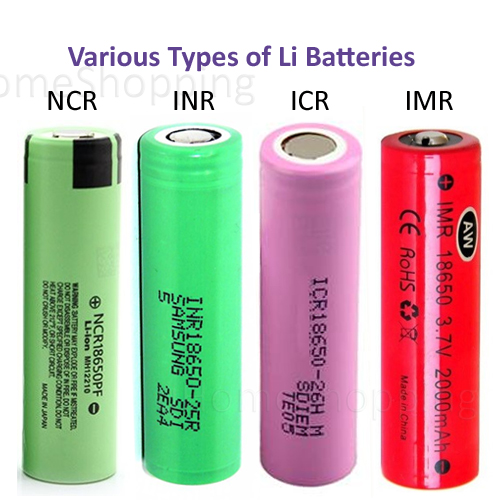
Besides size and capacity, you may notice the 3 letter codes on most Li batteries like ICR, IMR, INR, NCR, etc. printed on the battery like the Samsung ICR18650-26F, INR18650-30Q, Panasonic NCR18650B, etc. These are various types of Li-ion batteries . The 3 letter codes are manufacturer codes, and most but not all, use this as a standard way to refer to the different types of cells.
"I_R”;
The first Letter "I" just means that the cell is a Li-ion rechargeable.
Second letter refers to the cathode material.
The last letter "R" just means the cell is round.
ICR = Li-ion Rechargeable, the "C" = Cobalt.
IMR = the "M" stands for Manganese, or "Mn".
INR = the "N” stands for Nickel.
IFR = the "F" stands for the element "Fe" which is Iron.
INR seems to have rather similar proterties to IMR i.e. low internal resistance and delivery high current without causing the battery from getting too hot. It is also classified as a safer chemistry so it's another ideal high drain battery.
What about Panasonic NCR18650B?
The name NCR18650B is just Panasonic’s part number and it’s also a Lithium Cobalt battery, like an ICR cell. Panasonic does put some additional safety features that make it safest of any ICR cell.
The NCR18650B is available with and without protection. Again for protected cell, it may be offered as a rewrapped under different brand or same brand but the dimension will be longer and wider, so it may not suit some devices.
Capacity or mAh (milliampere hour) Rating - an approximation for how long a battery charge should last on a full charge. This is the battery capacity and is used to describe a battery's "fuel tank", as in general a battery with higher mAh ratings will last longer assuming that it's subjected to same usage patterns.
To estimate how long a battery last, divide the capacity of battery by the current consumed by device. For example, the battery is 3400mAh and a cree torch consumed 2.4A (2400mA), it will last 1.42 hours approx. If you use a 2600mAh, it last you only 1.08 hours only.
The "best battery" is not always the one with the largest mAh rating. In most applications a higher current rating (C-rating) determines the better battery.
The C rating is the maximum safe continuous discharge rate of a battery. If you see 10C on your battery, it means it can be discharged at 10 times that cell’s capacity.
Capacity refers to the milliamp-hour rating of the battery, which will be listed as a number followed by mAh (2000mAh, for example).
Here's the easy way to find your battery's discharge rate; just multiply the number from the C rating by the cell's capacity. Keep in mind that 1000 milliamps equals one amp. Here's an example, using an 3.7V 2000mAh 10C
3.7 volt 2000mAh -10C
2000 milliamps = 2 amps
2 Amps x 10 = 20 amps continuous discharge
This means that you can safely draw up to 20 amps continuously from that 3.7V 2000mAh 10C without doing damage to your battery.”
Example Samsung ICR18650 26-F 2600mAh 2C. It means the max. continuous discharge current is 5.2A (2.6x2). Now you know why this battery price is so low, because of low C-ratings and also not really a high capacity (mAh) battery.
This "Maximum continuous discharge current" (MCDC), is the maximum electrical current at which the battery can be discharged continuously before the battery will fail. This specification is set by the manufacturer, and is a standard measurement in the industry.
The "pulse or burst discharge rate" is not a standard measurement and varies from one manufacturer/vendor to another, making comparisons from company to company impossible, and therefore should never be relied upon.
Some sellers or rewrappers put the Pulse discharge rate on battery to confuse buyers as max. continuous discharge rate. For those who required a High Drain battery for their application, they have to take special note of this max. continuous discharge current rating.
Though this max. continuous discharge current is a current that will not overheat and destroy the battery, but note that discharging battery with max. allowed current will shorten the battery life significantly and the real available capacity will be less than nominal.
Some sellers will just termed it as CDC or CDR (Continuous Discharge Current or Rate). You should be shown or ask for the max. continuous discharge current of your battery before you purchase it;
Sometimes you see a 18650 battery spec as 3.7V, example the Samsung ICR18650-26F, but some may said it is 4.2V, why? The 3.7V is the Nominal Voltage while the 4.2V is the Charging Voltage. So when fully charged, it’s 4.2V and in fact 3.6V is the actual nominal voltage of most ICR batteries, while most IMR batteries are around 3.8V. There are 3.6V, 3.7V and 3.8V nominal voltage due to the slight variances in chemical composition in different cells.
Another important thing to know is "Thermal Runaway”. This is a chemical reaction inside the battery generally caused by the battery getting too hot, which fuels the reaction makes it get even hotter, and on and on. Pressure built up inside the cell and the battery is flammable and can react with the oxygen being released, which may make the cell explode. This happens very quickly in ICR batteries due to the composition of the cobalt cathode and their high energy density. For IMR, the lower energy density and chemical composition of the manganese cathode, you tend to get a "vent with flame” instead of an explosion. The flame is self-fueling and semi-sealed, so will likely burn itself out before you are able to put it out by some other method. Because of this, IMR is deemed "safer” chemistry then ICR.
So how to avoid a Thermal Runaway?
Avoid overcharging and getting the batteries too hot. Batteries can get into thermal runaway due to overcharging and from discharging too rapidly like a hard short circuit. Also if your device draws more current than the battery is rated for, the battery can get very hot.
This is very important as many buyers think any chargers will do and try to save cost on a charger (charger that cost around S$10 or even lesser). Most original batteries from the 4 giants do not have protection circuit. Also try to let battery rest for a while to cool down after charging.
In summary, price is not the only factor you consider when purchasing your 18650 battery. Maximum continuous discharge current is one of the more important factors that you must consider besides the capacity (mAh). If you choose the wrong C-ratings, and you are draining your battery more than it’s rated for, your battery may get into thermal runaway which is dangerous.
High Drain Vs Regular :
First what is a high drain 18650 battery? High drain batteries can handle higher current load than regular batteries, in simple terms, high drain here means for high current devices like your power tools which require high current to work, and also hoverboard, e-scooter, etc.
If you put a regular battery in high current load devices, they will be overstressed and shortened their life cycle. In some cases, if the current drawn at a given voltage exceeds the max continuous discharge current, the battery voltage "sags” (drop) reducing the current drawn, so a 3.7V battery may drop to like 3V. In worst cases, it will cause thermal runaway and is dangerous.
The high drain battery have a max continuous discharge current more than high enough to meet the current drawn without reducing the 3.7V and they are not overstressed so you can get the full capacity. They are also safer, as it is a more stable chemistry.
Most regular batteries are only 1C or 2C. Example the commonly available battery Samsung ICR18650 26F is only a 2C battery which means the max continuous discharge current is only 5200mA. That's why this battery is more suitable for laptop used and only about S$10 each.
Regular batteries are good enough for laptop, cree torch, remote control, etc. while High Drain batteries are mainly for high current load devices. In fact ICR batteries are considered obsolete for high drain current device use because of their low max continuous discharge current (low C-ratings) and potential for thermal runaway. Even protected ICR batteries are not used for this purpose.
I will touch on those commonly used Flat Top, High Drain batteries specially for high current load devices like power tools, hoverboard, e-scooter, etc. High quality IMRs or their hybrids are commonly used in place of ICR for all high current load devices.
IMR (Lithium Manganese) are the safest batteries available for high current load as the added manganese to carbon-based lithium batteries, make them become a safer chemistry and don't require the protective circuit. IMR batteries allow you to discharge at high current while maintaining low temperatures and this means safer than older ICR batteries and don't require protective circuitry.
INR (Lithium Manganese Nickel) is the reigning champ of the 18650 high drain world. Nickel is added making it a "hybrid" chemistry and combines the safety and low resistance of manganese and the high energy of nickel. Thus the resulting chemistry gives a reasonably high capacity with a high discharge current and is also stable. LG, Samsung and Sony are all developing such INR batteries with different ratio of manganese, nickel and cobalt.
How To Prolong The Lifespan Of Your Handphone Li-Ion Battery
Lifespan of a Lithium-Ion battery is about 400 to 500 charge and discharge cycles. Very much depends on your usage pattern, this is usually about 2 to 3 years. Even without using, the shelf life is still about the same. You will normally find a production date on your original battery but not on the compatible battery.
But in real life, we may only get about 80% capacity out of the battery (original) which means 320 - 400 charge and discharge cycles, or 1.6 to 2.4 years. If the compatible replacement battery is again about 80% as good as the original (for example), that results to be 256 - 320 charge and discharge cycles and 1.28 - 1.92 years. On average, a compatible battery costs S$11 or less, each charge and discharge costs you less than S$0.04 or less than S$0.02 per day! So it's wiser to have a couple of spare compatible batteries on standby for the heavy users. Also by the time the shelf life of the compatible battery runs out, one probably have already replaces his/her handphone with a new model.
All rechargeable Li-Ion batteries will expire in 2 to 3 years whether or not they are used. To prolong the shelf life, store in a cool dry place at approximately 40 percent capacity when not in use. That also means that in a hot country like Singapore, it will also shorten the lifespan of our battery and some apps will "heat" up your battery much more and sometimes you will find your battery bulge out and do not use it once that happens.
Since lifespan of the battery is about 400 to 500 charge and discharge cycles, the depth of discharge on a Li-Ion battery will determine its ultimate cycle count. According to Battery University, to extend the lifespan of your battery, you should recharge your battery frequently and let it drain as little as possible in between recharges.
Partial discharges are better and you should recharge when it drops to about 40% capacity. Li-Ion and Li-Polymer batteries, if charged often, after about 1 month, would reach maximum performance and have better lifespan. Li-Ion battery does not need to be fully charged as doing so will stress the battery. If fact don't discharge your battery all the way between charges and when you charge, don't top if off since Li-Ion battery lifespan is all about charging cycles. One charging cycle is the time between on full charge and one full discharge. You can partially charge and discharge you battery many times during a single charging cycle since your Li-Ion battery has no memory effect and you can recharge it in whole or partially, whenever you feel like it.
Normally charging your battery to 80% capacity is good enough and the next 2 hours, the battery will trickle-charge slowly to top it off. So by maintaining your battery between 40% to 805 capacity is better to prolong the lifespan.
Sometimes if a Li-Ion battery discharged below 2.5 volts per cell, a built in safety circuit of the battery opens and the battery appears dead. Your normal charger may not be able to charge it again. So we may have to be careful and avoid totally drain out the battery. Full discharges put a lot of stress on the battery and try not to discharge lower than 20% capacity.
One common misconception is that Li-ion batteries will only count charge cycles if the battery is completely drained in one single session or another is that the battery counts one charge cycle for every instance the device is plugged in and unplugged again. These is NOT true.
Li-ion batteries actually count charge cycles based on a 100 percent discharge even when it's summed over multiple sessions. For example, if you discharge a battery to 50 percent one day, charge it back to 100 percent, then discharge it 50 percent again the next day, that is counted as one "cycle" of the battery. So shallow discharges, in all these regards, are ideal for a Li-ion battery. Also the cycle percentage approach is the correct interpretation of charging cycles i.e. two 50% charges = a 30% plus a 70% = a 100% charge = one cycle.
To sum it all, maintain your battery between 40% to 80% capacity. Do not full discharge your battery and there is no need to charge up fully to 100%. With our new Universal Battery Charger with LCD Indicator, you can see the capacity of your battery and how much you want to charge it. The LCD Indicator shows 0, 25, 50, 75, and 100 percent capacity. So you can use the indicator to gauge your charging pattern better.
How to spot a Fake 18650 Battery?Click here


about 18650 Batteries and their applications
This is the final part and I will just touch on the commonly available batteries in Singapore market.
Always remember when looking for a suitable 18650 battery, the higher the capacity - the lower the max continuous discharge current.
So you must find a balance between capacity and the C-rating. No point going after a high C-rating if you know for sure you don't need higher than that, eg - if all you need is 10A, then for 10A choose the highest capacity like the new LG INR18650 MJ1 - 3500mAh, 10A. If you need a 20A for your device, then the highest capacity probably is the LG INR18650HG2 - 3000mAh, 8C 20A.
If you are choosing a battery for your cree eg. a T6 cree torch. Maximum current drawn for T6 cree is 3A. A T6 is usually 10W, and using a 3.7V or 3.6V will draw about 2.7A to 2.8A. So choosing a C-rating that is about double, the battery will not be so hot if on for a longer time. The Panasonic NCR 18650B - 3400mAh, 4.875A is an obvious choice as it has the highest capacity of 3400mAh with a C-rating of 4.875A. In fact most forums put the C-rating for this battery to be 2C 6.8A.
http://flashlightwiki.com/Cree
Regular Batteries - Mainly for Cree Torch, Laptop and non high current load devices;
I will not recommend rewrapped brand like Efest, Olight, AW, Ultrafire, etc. in this article as one may not know what's really inside the wrap.
Green color. Ideal for cree and low current load. Not suitable for high current load devices like power tools, though some not so demanding high current load still ok.
Note : Some sellers may have the protected version which the length is longer so take note as it may not fit in your device or some chargers. Many forums put this battery as 2C 6,8A.

http://gamma.spb.ru/media/pdf/liion-lipolymer-lifepo4-akkumulyatory/ICR18650-30B.pdf
Green color. Ideal for cree and low current load. Not suitable for high current load devices, though some not so demanding high current load still ok.
Note* : It is a good battery but requires a 4.35V special charger in order to achieve full capacity performance. Using a normal 4.2V charger will not give optimal performance. This explains why some sellers are clearing it at lower price.

Pink color. Ideal for laptop or cree. Not suitable for high current load. Those using it for high current device may experience cut-off when the current surge too high.
Note : Some sellers are selling this recycled from the laptop powerpack battery, may be used or new. ICR18650 26FM is made in Malaysia and you will see the print "SDIEM"


Flat Top, High Drain Batteries - Mainly for high current load devices like power tools, e-scooter, hoverboard, smart balance board, etc.
I will not recommend rewrapped brand like Efest, Olight, AW, Ultrafire, etc. in this article.
Green color. Ideal for all purposes including high current load devices like power tools, e-scooter, hoverboard, smart balance board, etc.
Note : New and one of the highest capacity 3,500mAh with 10A max continuous discharge current, INR18650 MJ1 from LG matching the Panasonic.

Dark Chocolate color. Ideal for all purposes including high current load devices like power tools, e-scooter, hoverboard, smart balance board, etc.
Note : High in capacity and high in max continuous discharge current. Ideal if you wanted a good balance between capacity and C-ratings. 3000mAh with 20A to boost.

3.Samsung INR18650 30Q - 3000mAh, 5C 15A.
Light Purple color. Ideal for all purposes including high current load devices like power tools, e-scooter, hoverboard, smart balance board, etc.
Note : An average capacity of 3000mAh and 15A max continuous discharge current.
Green color. Ideal for all purposes including high current load devices like power tools, e-scooter, hoverboard, smart balance board, etc.
Note : Sony no longer manufactured the 18650 (VTC) type and that news was some years back when when Fukushima was hit by earthquarke. This product was meant for OEM makers of specific devices and thus not eligible for warranty or engineering support. Specifications and markings on battery may vary depending on OEM's requirements. Difficult to determine authenticity of these batteries and also many fake VTC available. So please buy from reputable sellers if you still want a VTC. This include all Sony VTC type batteries.
Now news was that the VTC5 was back in production in Philippines since Aug 2014. Check it out here; https://www.reddit.com/r/electronic_cigarette/comments/2dc44l/sony_is_not_discontinuing_the_vtc_line_of/
So true or not, up to you to believe. But there are many fakes VTCs around, so take not.
Yellow color. Ideal for all purposes including high current load devices like power tools, e-scooter, hoverboard, smart balance board, etc.
Note : Some sellers put 35A but this is the LG spec which states 20A. 35A is the max pulse discharge. ;
http://www.protovapor.com/wp-content/uploads/2014/12/20141014-LRB-PS-18650HE4.pdf
Green color. Previously Light Blue color. Ideal for all purposes including high current load devices like power tools, e-scooter, hoverboard, smart balance board, etc.
Note : The Samsung 25R and LG HE2 seems like a close match both rated 20A. There may be some fake 25R especially the light blue older version.

Red color. Ideal for all purposes including high current load devices like power tools, e-scooter, hoverboard, smart balance board, etc.
Note : Some selling it as 30A or 35A, which 35A is the max pulse discharge rate, not the max continuous discharge rate. See the difference between HE2 and HE4;
In conclusion, decide on the max continuous discharge current first then the capacity and not just the price alone. Also make sure the charging voltage is 4.2V and no need any special charger. Think whether do you want a rewrapped battery or a good genuine battery from the 4 giants. Take your battery seriously, paying $10 or less for a bad battery is not a good deal as paying a bit more for a good one is going to last you longer and serve you better.