The authors of Gamestorming have a different perspective. They contend that an embrace and understanding of game mechanics can yield benefits in many work environments particularly those where old hierarchical models are no longer applicable like the creatively driven knowledge work of todays cutting edge industries.
Here is one of the 83 games featured in Gamestorming:
The ELEVATOR PITCH Game
OBJECTIVE OF PLAY: What has been a time-proven exercise in product development applies equally well in developing any new idea: writing the elevator pitch. When developing and communicating a vision for something whether its a new service a company-wide initiative or just a good idea that merits spreading a group will benefit from going through the exercise of writing their elevator pitch.
Often this is the hardest thing to do in developing a new idea. An elevator pitch must be short enough to deliver in a fictional elevator ride but also contain a compelling description of the problem you??re solving?? who you??ll solve it for?? and one key benefit that distinguishes it from other ideas.
NUMBER OF PLAYERS: Can be done individually?? or with a small working group
DURATION OF PLAY: Save at least 90 minutes for the entire exercise?? and consider a short break after the initial idea generation is complete before prioritizing and shaping the pitch itself. S"rking groups will have an easier time coming to a final pitch; in some cases it may be necessary to assign one person with follow-up accountability for the final wording after the large decisions have been made in the exercise.
HOW TO PLAY: Going through the exercise involves both a generating and a formative phase. To set up the generating phase?? write these headers in sequence on flip charts:
- Who is the target customer?
- What is the customer need?
- What is the product name?
- What is its market category?
- What is its key benefit?
- Who or what is the competition?
- What is the product??s unique differentiator?
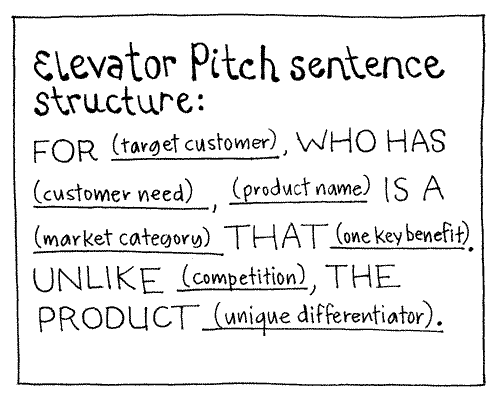 |
To finish the setup explain the elements and their connection to each other:
- The target customer and customer need are deceptively simple: any relatively good idea or product will likely have many potential customers and address a greater number of needs. In the generative phase all of these are welcome ideas.
- It is helpful to fix the product name in advance--this will help contain the scope of the conversation and focus the participants on what the pitch is about. It is not outside the realm of possibility however that useful ideas will be generated in the course of the exercise that relate to the product name so it may be left open to interpretation.
- The market category should be an easily understood description of the type of idea or product. It may sound like employee portal or training program or peer-to-peer community. The category gives an important frame of reference for the target customer from which they will base comparisons and perceive value.
- The key benefit will be one of the hardest areas for the group to shape in the final pitch. This is the single most compelling reason a target customer would buy into the idea. In an elevator pitch?? there is no time to confuse the matter with multiple benefits--there can be only one memorable reason ??why to buy.?? However?? in"generative phase?? all ideas are welcome.
- The competition and unique differentiator put the final punctuation on the pitch. Who or what will the target customer compare this idea to?? and what??s unique about this idea? In some cases?? the competition may literally be another firm or product. In other cases?? it may be ??the existing training program?? or ??the last time we tried a big change initiative.?? The unique differentiator should be just that: unique to this idea or approach?? in a way that distinguishes it in comparison to the competition.
The Generating Phase
Once the elements are understood?? participants brainstorm ideas on sticky notes that fit under each header. At first?? they should generate freely?? without discussion or analysis?? any ideas that fit into any of the categories. Using the Post-Up technique?? participants put their notes onto the flip charts and share their ideas.