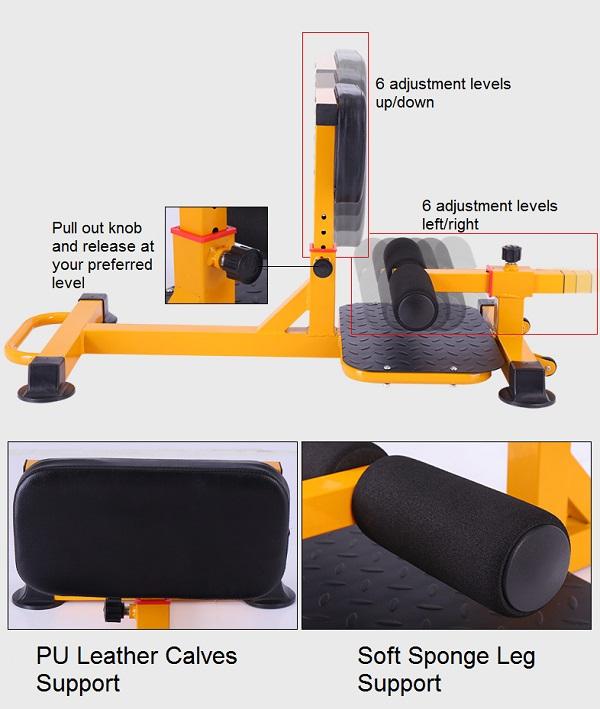
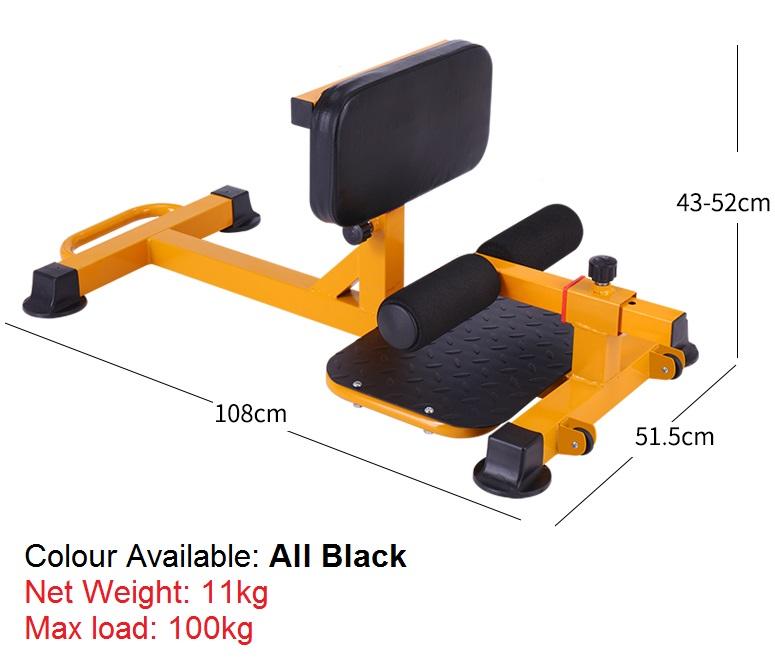
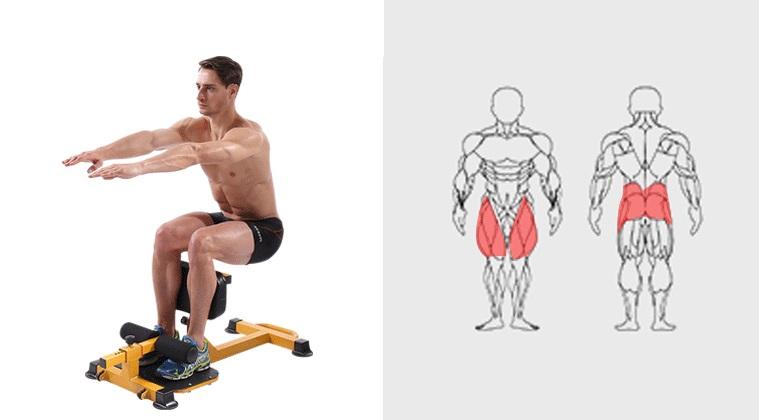
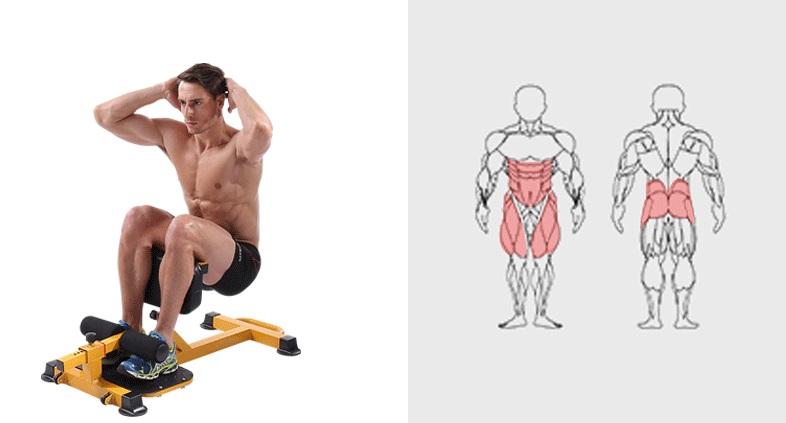
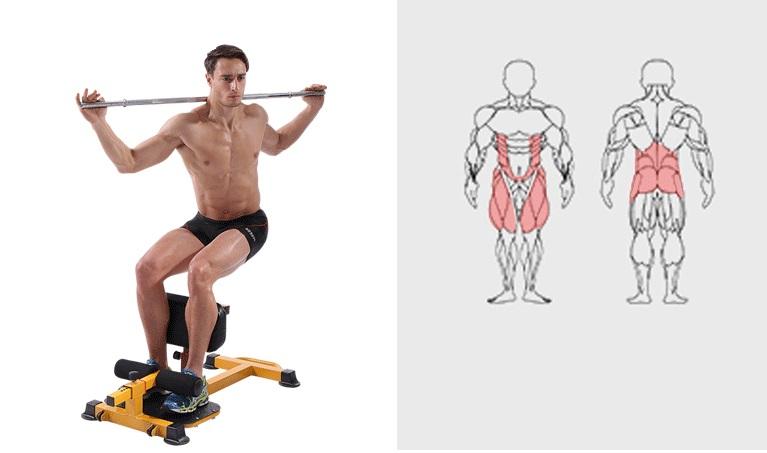
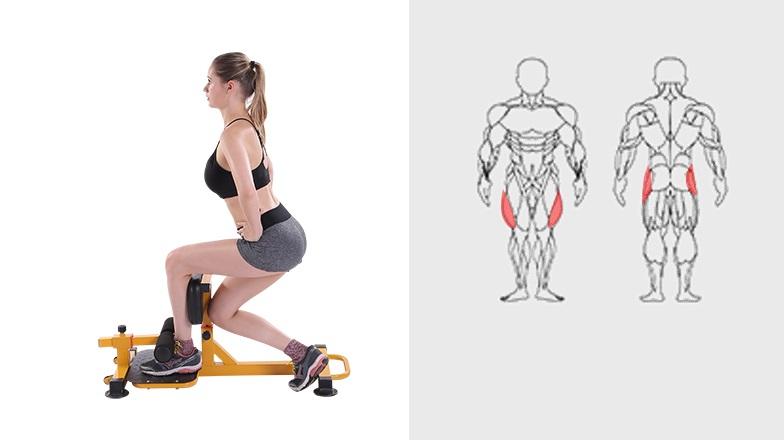
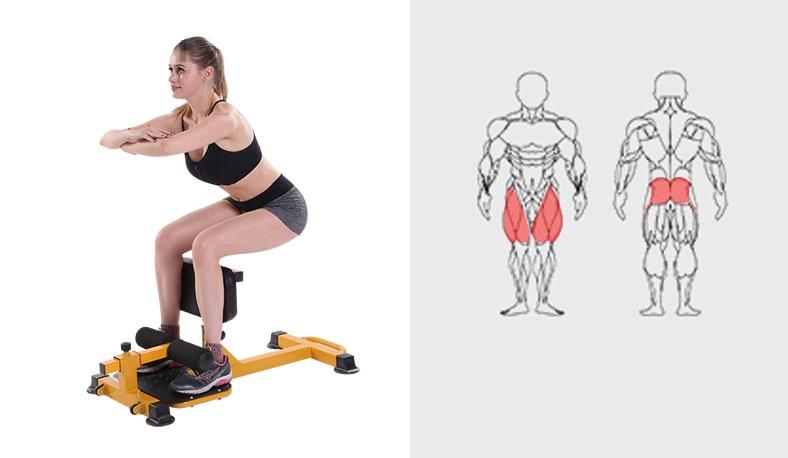
There is nothing ‘Sissy’ about a Sissy Squat. This particular style of squat is more difficult than most other forms of squatting. One of the main advantages of Sissy Squats is achieving almost 100% isolation on the quads. Sissy Squats are also an excellent alternative to regular squats for anyone suffering from back injury or other problems preventing them from squatting normally as little stress is placed on other muscles.
Solid, compact and effective, the Sissy Squat is strong enough for gym use, while designed to fit into any home. Featuring SteelForce Structural Integrity and heavy-duty, high density foam padding wrapped in sewn rip-stop upholstery, the SISSY is built to take a pounding.
The Sissy Squat will help you build your quads with near 100% isolation! Push yourself to failure knowing that you are exercising on one of the safest and most effective Sissy Squats available!
The Top 8 Benefits of Squats
What makes squats such a fantastic exercise?
1.Builds Muscle in Your Entire Body
Squats obviously help to build your leg muscles (including your quadriceps, hamstrings, and calves), but they also create an anabolic environment, which promotes body-wide muscle building.
In fact, when done properly, squats are so intense that they trigger the release of testosterone and human growth hormone in your body, which are vital for muscle growth and will also help to improve muscle mass when you train other areas of your body aside from your legs.
So squats can actually help you improve both your upper and lower body strength.
2.Functional Exercise Makes Real-Life Activities Easier
Functional exercises are those that help your body to perform real-life activities, as opposed to simply being able to operate pieces of gym equipment.Squats are one of the best functional exercises out there, as humans have been squatting since the hunter-gatherer days. When you perform squats, you build muscle and help your muscles work more efficiently, as well as promote mobility and balance. All of these benefits translate into your body moving more efficiently in the real world too.
3.Burn More Fat
One of the most time-efficient ways to burn more calories is actually to gain more muscle! For every pound of additional muscle you gain, your body will burn an additional 50-70 calories per day. So, if you gain 10 pounds of muscle, you will automatically burn 500-700 more calories per day than you did before.
4.Maintain Mobility and Balance
Strong legs are crucial for staying mobile as you get older, and squats are phenomenal for increasing leg strength. They also work out your core, stabilizing muscles, which will help you to maintain balance, while also improving the communication between your brain and your muscle groups, which helps prevent falls – which is incidentally the #1 way to prevent bone fractures versus consuming mega-dose calcium supplements and bone
5.Prevent Injuries
Most athletic injuries involve weak stabilizer muscles, ligaments and connective tissues, which squats help strengthen. They also help prevent injury by improving your flexibility (squats improve the range of motion in your ankles and hips) and balance, as noted above.
6.Boost Your Sports Performance -- Jump Higher and Run Faster
Whether you're a weekend warrior or a mom who chases after a toddler, you'll be interested to know that studies have linked squatting strength with athletic ability.1 Specifically, squatting helped athletes run faster and jump higher, which is why this exercise is part of virtually every professional athlete's training program.
7.Tone Your Backside, Abs and Entire Body
Few exercises work as many muscles as the squat, so it's an excellent multi-purpose activity useful for toning and tightening your behind, abs, and, of course, your legs. Furthermore, squats build your muscles, and these muscles participate in the regulation of glucose and lipid metabolism and insulin sensitivity, helping to protect you against obesity, diabetes and cardiovascular disease.
8.Help with Waste Removal
Squats improve the pumping of body fluids, aiding in removal of waste and delivery of nutrition to all tissues, including organs and glands. They're also useful for improved movement of feces through your colon and more regular bowel movements.
How to Do Squats Properly
1) Warm up
2) Stand with your feet just over shoulder width apart
3) Keep your back in a neutral position, and keep your knees centered over your feet
4) Slowly bend your knees, hips and ankles, lowering until you reach a 90-degree angle
5) Return to starting position -- repeat 15-20 times, for 2-3 sets for beginners (do this two or three times a week)
6)Breathe in as you lower, breathe out as you return to starting position
The squat is great as it totally focuses on the quads and eliminates all other muscles from the movement. Along with developing your quads, this exercise will help develop your balance and even your core strength. Beginners should use only their body weight during the routine, but more advanced athletes would benefit by adding weight.
Because of their difficulty, squats are most commonly performed while using just your own body weight. However, you can hold a weighted plate against your chest to increase resistance. Set your feet to shoulder-width apart with your toes pointed forward. It’s a good idea to stand next to a vertical beam or other stable object that you can grip if needed. Keeping your hips and waist straight, bend your knees and push them forward so that your torso lowers backward. Your heels will rise up off the floor. Continue until your knees are fully bent or close to touching the floor and then extend your knees to return to a full standing position to complete the rep.
The major muscle that squats target are the quadriceps, which are a collection of four muscles that run down the front of your upper thighs and are responsible for flexing your knees. Your gluteus maximus, the largest muscle in your butt, is recruited, but it simply acts as a stabilizer along with your abdominal and obliques to help prevent your back from collapsing as you lower into the squat.
Story of why it is named Sissy Squat
Straight Outa Corinth
Let's get the obvious out of the way first: The sissy squat isn't for sissies. In fact, the name has nothing to do with the sexual orientation of people who do it, and everything to do with the mythical Greek king who inspired it – and who, let me tell you, was no poofter.
Sisyphus, as the legend goes, was the king of Corinth,. He was greedy, he killed travelers and guests (the ultimate crime in Greek mythology), and he seduced his own niece. But what really put his balls in the wringer was the time he tried to block Zeus.
Avid readers of Greek mythology know that Zeus, leader of the gods, combined a temper worse than John McEnroe's with the judicial instincts of Vlad the Impaler. Mess with him once, and he messed with you for eternity.
He sent Sisyphus to Tartarus, the lowest part of the underworld, and gave him a single task: push, pull, or carry a big stone up the side of the highest mountain, and leave it at the top.
Unbeknownst to Sisyphus, Zeus rigged the game so the former king could never actually reach the top with the stone. Each day he rolled it up as far as he could, and each day the gods arranged for him to fail, sending the rock rolling back down.
In its own way, weight lifting is a Sisyphean task – we lift weights day after day, week after week, year after year, and the weights never stay lifted. They always end up back where they started.
But that's not why the ultimate victim of "training to failure" has an exercise named after him. It's because of what all that work did for a certain part of his physique.
When you see Sisyphus depicted in ancient or modern art, he's almost always shown with bulging thighs, the finest pair of legs in ancient Corinth. He was the Tom Platz of classical mythology.
I saw my first rendering of Sisyphus some 50 years ago, and like any impressionable musclehead I was amazed at his leg development. The drawing I saw showed Sisyphus pushing with his back to the rock, digging his heels in for leverage.
I first heard about the sissy squat in 1960. An article in Joe Weider's Muscle Power magazine described the technique and mentioned the bodybuilders who used it – guys like Steve Reeves, Doug Strohl, Reg Lewis, and Monty Wolford.
I tried it and gained an inch on each of my thighs in less than three weeks. Even today, with all the options we have in our gyms and all the information that we didn't have in my youth, I consider it one of the most productive exercises you can do for your quads.