E-P3 SUMMARY
Olympus upgrades their high-end PEN line with a load of new enhancements while maintaining the retro look of the original. The sensor size also stays the same, but is said to be enhanced for better performance in low light, though we couldn't see much of a difference. It's the new targeted touchscreen interface that really impresses, allowing easy autofocus confirmation via onscreen zoom, and the autofocus itself is so fast it rivals many SLRs.
PROSExtremely fast autofocus; Pop-up flash and AF-assist lamp; Full HD recording; wisely limited focus for touchscreen; excellent print quality results; removable grip.
CONSLarger than some competitors (see E-PL3 if you prefer a smaller camera); strong noise suppression; touchscreen easily activated by mistake; list of options is overwhelming; shoulder strap D-rings are noisy.
PRICE AND AVAILABILITYThe Olympus PEN E-P3 shipped in the US market from August 2011. Four different kits are offered, both priced at approximately US$900, and differing solely in body and kit lens color--black or silver--and the choice of bundled kit lens. One kit includes the MSC M. Zuiko Digital ED 14-42mm II R f/3.5-5.6 zoom lens, and the other ships with the MSC M. Zuiko Digital ED 17mm f/2.8 prime lens.
IMAGING RESOURCE RATING4.5 out of 5.0
Olympus PEN E-P3 Overview
by Shawn Barnett, Mike Tomkins, and Zig Weidelich
Hands-on Preview posted 6/30/2011
Review posted 1/16/2012
A couple of years have passed since we reviewed the very first Olympus PEN camera, the E-P1. It seems longer, because so much has changed in this space. The PEN E-P1 was the first of the small Micro Four Thirds cameras, at the time the smallest, but since its debut a war has broken out for the title of the smallest compact system camera. While the smaller Olympus PEN Lite and PEN Mini have entered the fray in the "small" arena, Olympus saw fit to also update and revamp the original PEN with more functionality.
Sensor size remains the same, but Olympus says that it's been optimized for better high ISO performance. The company also added a removable, upgradable grip, an AF-assist lamp, a pop-up flash, and optional touchscreen control, among other things. Though it's a little surprising they stayed with the basic overall size and shape given the competitive environment, it does give them a larger platform to hang features on, better for the more serious photographer, who's likely to prefer the extra dial and buttons. Perhaps the most important improvement is the extremely fast autofocus, which rivals the fastest digital SLRs, a remarkable achievement, quite vindicating the brand after legitimate complaints of very slow autofocus with the first camera and lenses. That's all turned on its head now, as all of the current Olympus optics are fast and quiet, and the new FAST AF engine in this new line of cameras completes the picture.
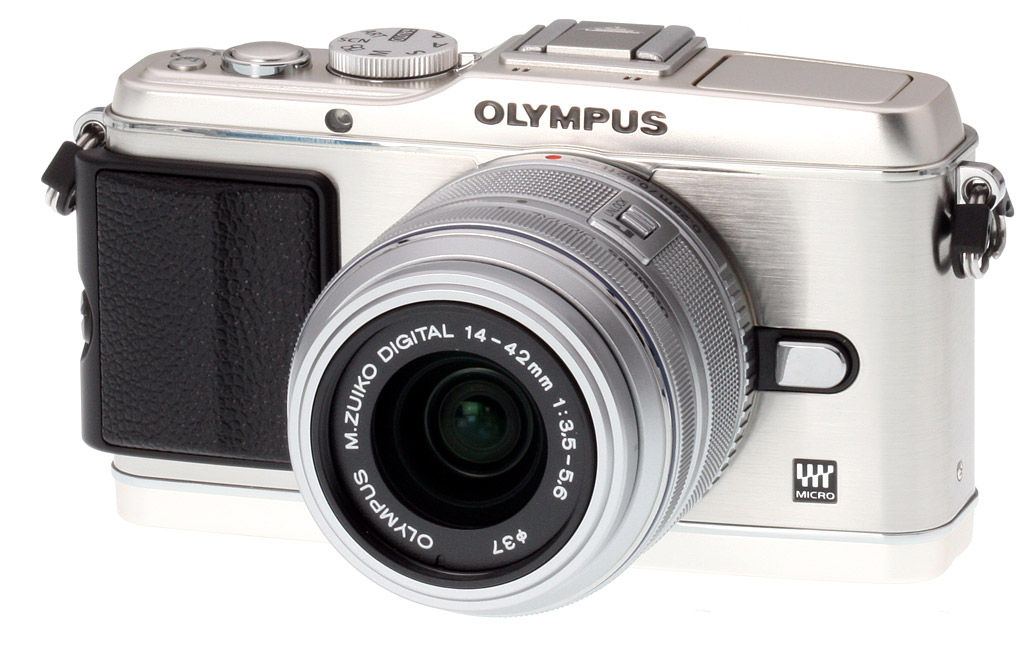
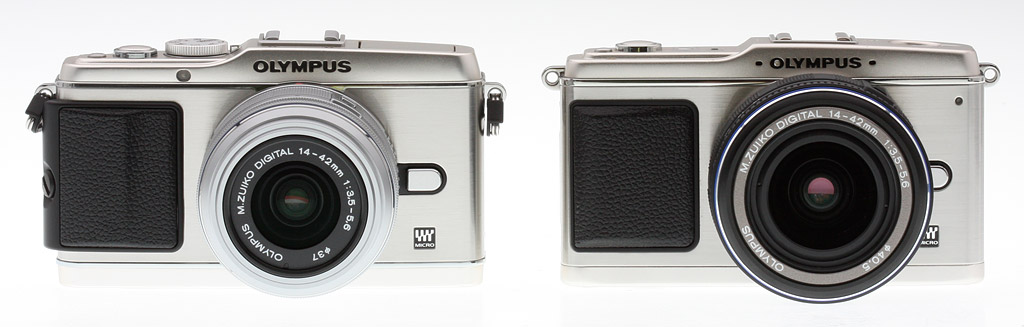
The new 14-42mm kit lens design, which debuted with the E-PL2 in 2010, has a new look, with a silver body and finer knurling on the rings. The old design also left the bayonet exposed, while the new adds a silver beauty ring for a more finished look. Removing the ring exposes the black bayonet mount for adding optional adapter lenses. The E-P3 we received had a champagne finish, making the silver lens look almost blue by comparison.
From the view at right, you can see the new Pop-up flash, tucked into its silo in this shot. Since this is where the Mode dial used to reside, they moved it to the right next to the shutter button, making it easier to see and use.
Build. Fully outfitted and ready to shoot, the Olympus E-P3 weighs just over a pound, or 16.96 ounces (1.06 pounds, 481g) with the lens, battery, and card. The original E-P1 configured the same with its original lens weighed a little more at 18.58 ounces (1.16 pounds, 526.8g). Dimensions seem similar to the E-P1 as well, at 4.8 x 2.7 x 1.35 inches (122 x 69 x 34mm). Measuring with a caliper, the actual dimensions are different: 123 x 71 x 35mm for the E-P3, versus 122 x 71.5 x 35.3mm. So, pretty close: a little shorter, a little wider, and a little thinner front to back. Note, I did include the hot shoe and lens mount, but not the strap lugs or grip.
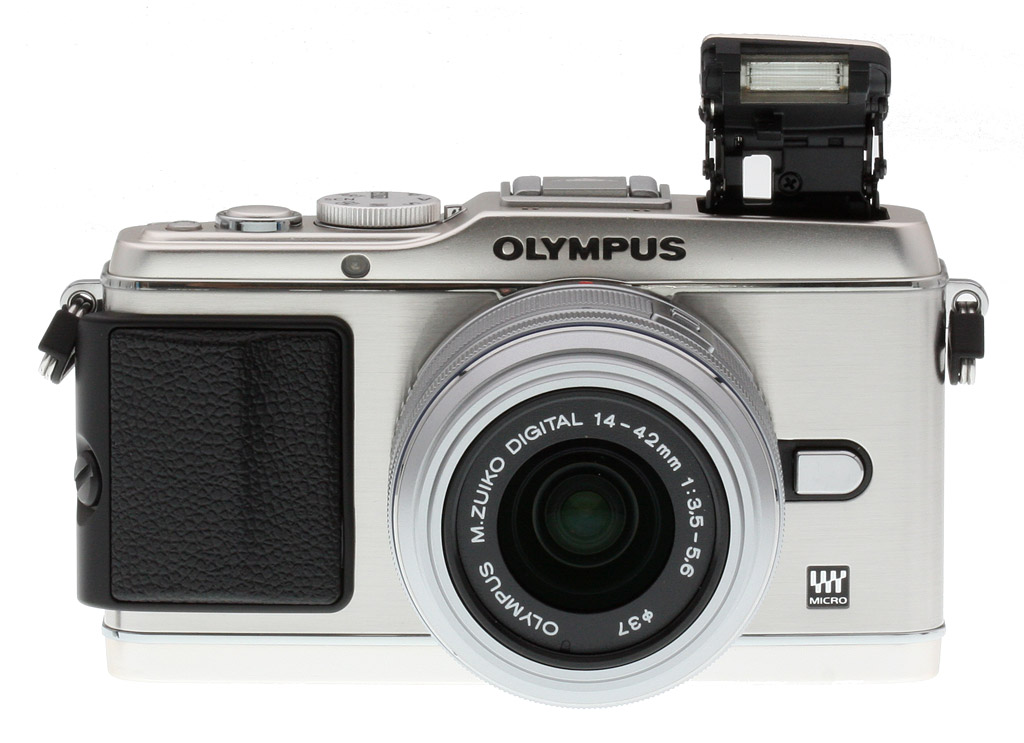
Prominent in this shot is the pop-up flash. It looks like the tube is about the same size as the flash on the E-PL2, but the mechanism is a little better built, with metal parts for more precision actuation. There's nothing wrong with the other design, by the way, it just makes more of a boing sound while this one is a single, solid click.
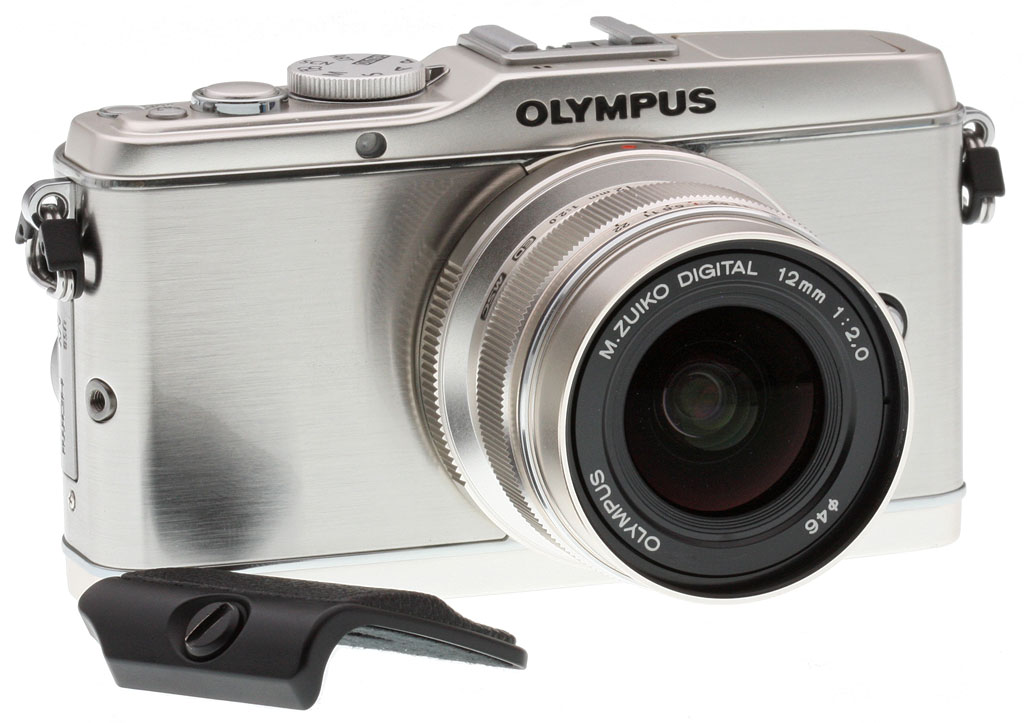
The new stock Olympus grip has a little more of a finger grip than the old design, which was more of an uncomfortable wedge. The new grip is removable, or you can replace it with a thicker, more aggressively hooked grip. I prefer it removed, so far. I always wanted to see if I could scrape the old one off, but never wanted to ruin it. Now I'd like to put some leather on the panels to make it small, yet grippy.
Also new on the front is the AF-assist lamp, which glows a bright amber when activated; it also flashes less brightly for the Self-timer. The Olympus logo, which was flanked by stereo microphone holes, now looks cleaner, as the microphone holes have moved to the top deck.
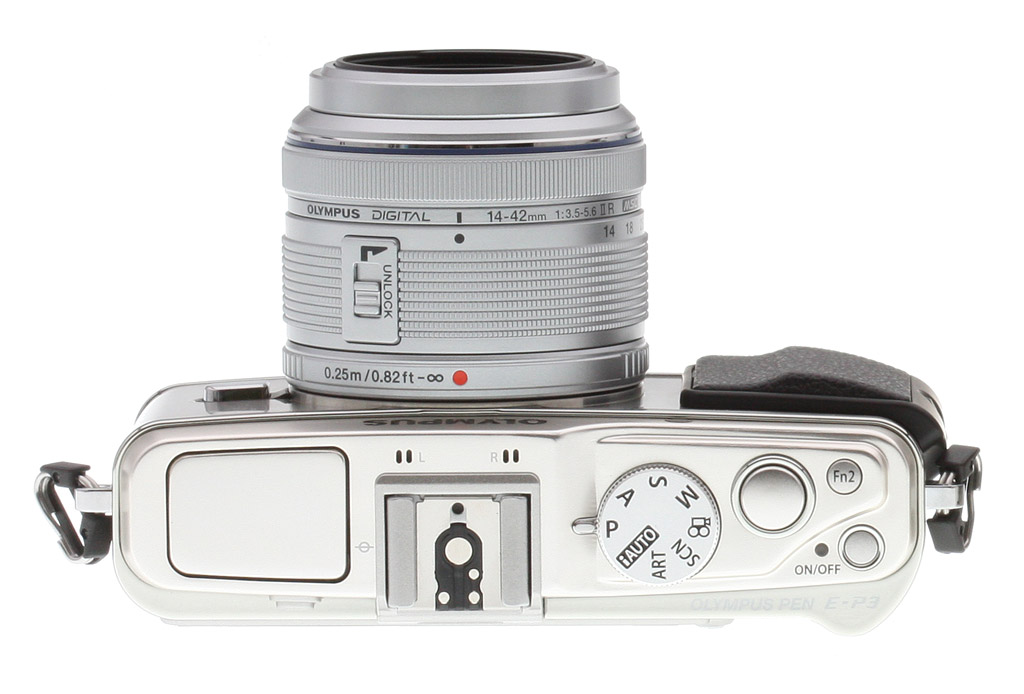
The color difference between the silver body and the silver lens is more dramatic in this view, but Olympus's own shots show this difference, so it's intentional. Those microphone holes push the hot shoe back a bit, or else that could be moved to accommodate the AP2 accessory port (below). The Mode dial is better positioned on the right side, but it doesn't match the rest of the camera as well. The power button has moved, and the SSWF (supersonic wave filter) is replaced with a blue power-on lamp. The shutter button is slightly smaller, and what used to be the Exposure Compensation button is now a programmable Function 2 button.
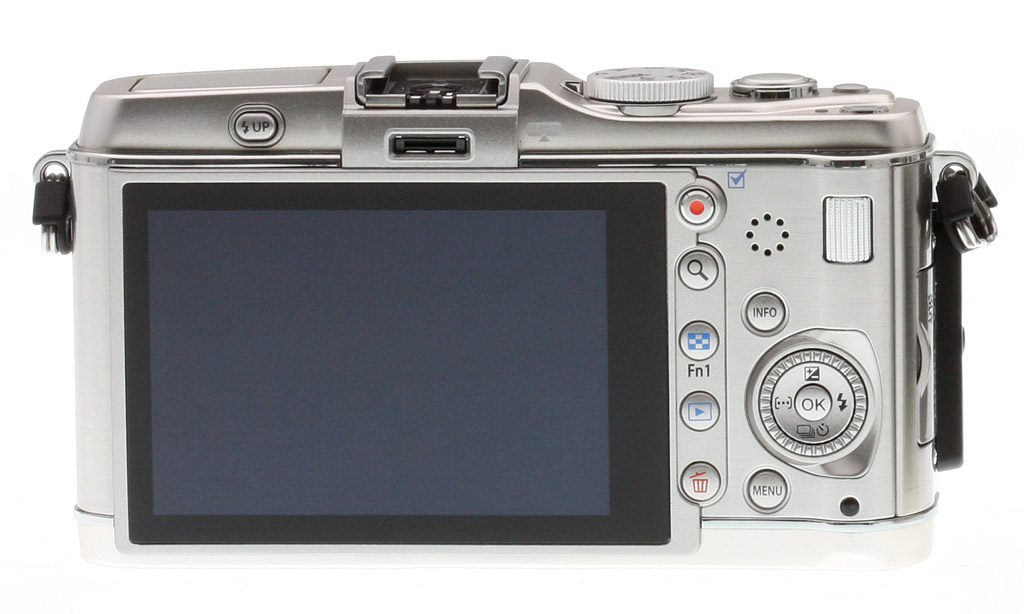
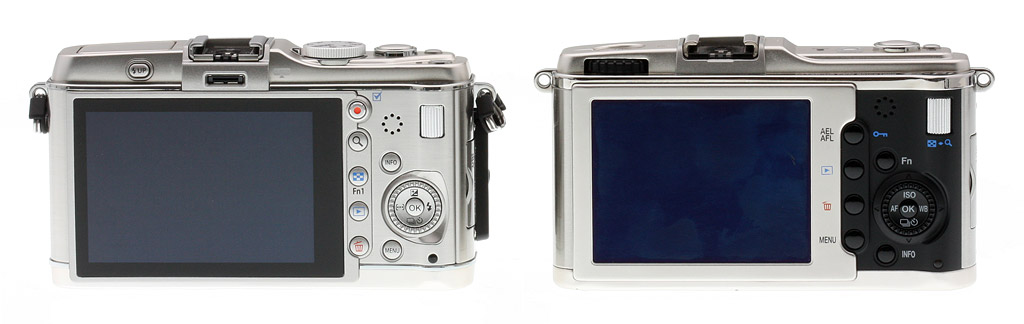
Major controls on the back match those on the original camera in orientation, though some have changed their purpose. New are the Pop-up flash release and the Record Start button, for instant access to movie recording. White Balance is no longer available on the right of the Arrow Pad/Main Dial, shrewdly replaced by the Flash Mode button. Though the vertical Sub dial on the upper right still serves to zoom in and out on images, there's a Zoom button where AE/AF Lock used to live. The other new control is the big rectangle to the left, the new touchscreen. Thankfully, its use is limited, meaning most of the functions haven't been delegated to the screen. Mostly Live Guides, touch focus, touch tracking, and zooming can be done via touch. I'm no fan of touchscreens, but this implementation might change my mind. The 3-inch monitor isn't an LCD, but an OLED with about 614,000 dots.
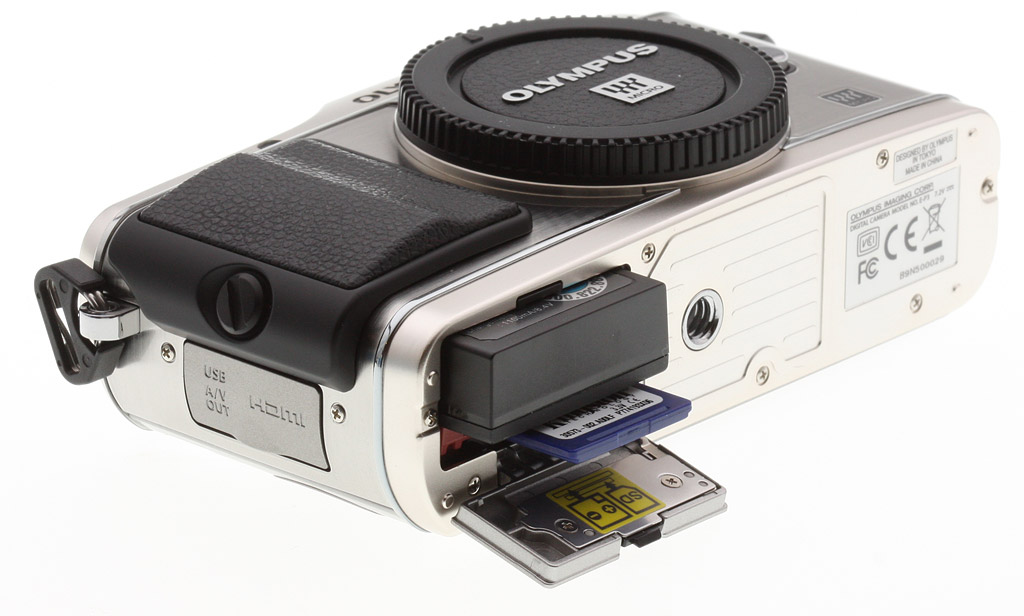
Storage and battery. The Olympus E-P3 stores images and movies on Secure Digital cards, and is compatible not only with the higher-capacity SDHC and SDXC card types, but also with higher-speed UHS-I cards -- still a relatively rare capability as of this writing (June 2011). The E-P3 also supports Wi-Fi enabled Eye-Fi Secure Digital cards, for wireless transfer direct from the camera body.
The Olympus E-P3 draws power from a proprietary BLS-1 (or BLS-5) lithium ion battery pack. Battery life is rated to CIPA testing standards as 330 shots with 50% flash usage, when writing to a class 6 SDHC card.
Olympus PEN E-P3 Technical Info
by Mike Tomkins
Sensor and processor. At the heart of the Olympus E-P3 lies a new 12.3 megapixel Live MOS image sensor, whose output is handled by a TruePic VI image processor. The E-P3's imager has a 4:3 aspect ratio, and allows capture of still images at a maximum resolution of 4,032 x 3,024 pixels. Sensitivity ranges from a base of ISO 200 equivalent to a maximum of ISO 12,800 equivalent, controlled automatically or manually in 1/3 or 1/2 EV steps. (By default, the maximum sensitivity is capped at a more modest ISO 1,600 equivalent, however.)
Two generations removed from the TruePic V chip featured in earlier PEN-series models, the new TruePic VI image processor retains the Fine Detail Processing technology introduced in the E-5 digital SLR's TruePic V+ chip, and adds Real Color technology that's intended to improve rendering of emerald green, yellow, and magenta hues. TruePic VI also includes an updated version of the company's Shadow Adjustment Technology, which operates in iAuto mode or when the Auto Gradation function is enabled, and aims to restore shadow detail without adversely affecting highlights.
Another new feature of the TruePic VI processor allows it to perform noise reduction using information spanning multiple frames, which should allow reduced noise levels both for video capture, and for the live view feed used to frame and review images. TruePic VI also brings a significant improvement in operating speed, most notable in the camera's autofocus system (which we'll come to in a moment), as well as in its ability to capture Full HD video -- a first for a PEN-series camera. Shutter response time is rated by the manufacturer at less than 60 milliseconds, a number confirmed in our lab.

Focusing. Perhaps the biggest news in the Olympus E-P3 is to be found in its overhauled autofocusing system. It still uses contrast detection autofocusing, but Olympus has improved the speed of its system significantly, and branded it as "Frequency Acceleration Sensor Technology", or "FAST" AF for short. Olympus claims its new system offers the world's fastest autofocusing with standard zoom lenses, finally bringing contrast detection autofocus on par with phase detection in terms of speed: comparing to its own product line, Olympus suggests that the E-P3 can focus as quickly as its prosumer Olympus E-5 digital SLR. The improvement in speed has been achieved by reducing the time taken for the autofocus system to begin operation after half-pressing the shutter button, doubling the sensor readout speed to a whopping 120 frames per second, and increasing the speed with which contrast detection routines operate. Olympus' "Movie and Still Compatible" lenses are also said to play their part in the system's speed, and third party lenses or older Olympus models are likely to operate at reduced speed.
As well as improving autofocus speed, Olympus has also increased the total number of focus points in its system, which still has fixed point locations, even though it uses contrast detection. Where earlier PEN-series cameras offered 11-point autofocus, the Olympus E-P3 now offers up 35 point focusing, with the points are arranged in a 7 x 5 array that covers most of the image frame, with the exception of the extreme edges. The E-P3 also provides the ability to configure the camera to address 3x3 groups of focus points instead of individual points if preferred. Olympus further notes that it has improved autofocus tracking performance, and can now use color information and account for the locations of faces in tracking a moving subject. One final difference of note with respect to autofocusing is that the Olympus E-P3 now includes a small, built-in autofocus assist lamp, positioned roughly where the self-timer lamp was in earlier cameras.
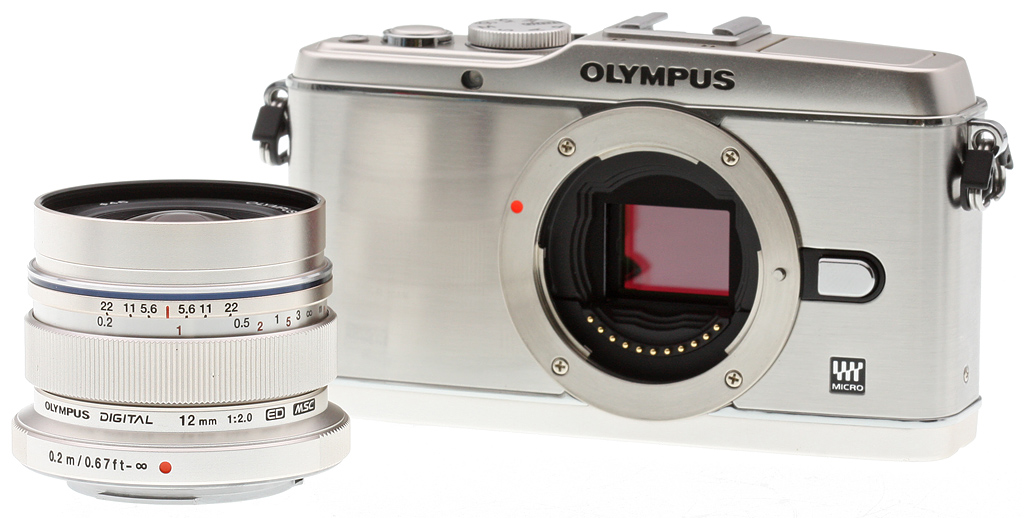
Optics. Like all PEN-series cameras, the Olympus E-P3 features a Micro Four Thirds lens mount capable of accepting quite a selection of dedicated lenses from Olympus, Panasonic, and Voigtländer. Courtesy of several adapters, it can also accept older glass including OM-series lenses, Leica's M and R-mount lenses, and lenses made for Olympus and Panasonic's full-sized Four Thirds cameras.
As noted previously, the new "FAST"-branded autofocus system derives the best benefit with Olympus' MSC lenses, and so E-P3 owners will likely want to stick with these models for swifter, quieter autofocus. As of this writing (late June 2011), there are five MSC-branded zoom lenses on the market, covering everything from an 18mm-equivalent wide angle to a 600mm-equivalent telephoto, and prime-lovers will be happy to hear that Olympus has just announced two MSC prime lens models due to ship soon.
Performance. The big story of the Olympus E-P3 in terms of its performance is to be found in the aforementioned autofocus system. Burst shooting performance is rather more modest, being manufacturer-rated at three frames per second. Thanks to support for high-speed UHS Secure Digital cards, burst depth is pretty good, however. The Olympus E-P3 is capable of shooting as many as 17 raw frames in a single burst, and will continue to capture large/normal JPEG still images without slowing for as long as there's available card space and battery power to do so, presuming the card being used is up to the task.

Stabilization. As with its predecessors, the Olympus E-P3 includes a sensor-shift image stabilization system with three operating modes. In Mode 1, the E-P3's IS system will correct for either horizontal or vertical motion. In Modes 2 and 3, the IS system will instead correct only for vertical motion, allowing horizontal panning with landscape or portrait-orientation framing respectively.
Dust reduction. Another function that's held over from past PEN-series models is Olympus' patented Supersonic Wave Filter dust reduction system. This operates by using a piezoelectric element to vibrate a filter glass overlying the sensor, shaking free dust and other particles which are then captured on an adhesive membrane beneath the imager. The system operates whenever the camera is powered on, and we've subjectively found piezoelectric systems like these to be significantly more effective than those using lower-frequency motion from a sensor shift assembly.
Display. On the rear panel of the Olympus E-P3 is a 3.0-inch, 3:2 aspect Organic LED screen with a touch panel overlay, allowing it to serve double-duty as an input mechanism. The E-P3's OLED panel has a total resolution of 614,000 dots, equating to approximately 205,000 pixels, with each pixel comprising separate red, green and blue dots. The display has a wide 176-degree angle of view and is said to be bright enough to compose images "even in harsh midday light". It offers two operating modes--vivid and natural color--as well as a +/- two step brightness adjustment, and a +/- 3 step color adjustment.
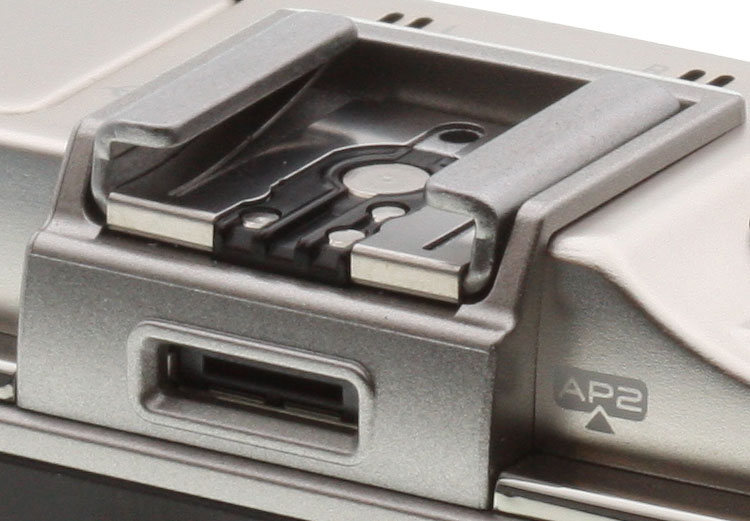
Accessory Port 2.
Viewfinder. The Olympus E-P3 includes a small accessory port just beneath and behind its flash hot shoe, a design first seen in the preceding E-P2 model which allows the camera to accept a number of accessories, including the VF-2 electronic viewfinder. We've described this device in past reviews, and it's rather a nice design. A little bulky perhaps, and its use prevents an accessory flash strobe being mounted, but it has high SVGA resolution, a 100% field of view, 1.15x magnification, and a tilt mechanism allowing viewing from overhead.
The same accessory port also accepts Olympus' EMA-1 external microphone adapter, MAL-1 Macro Arm Light, and PENPAL Bluetooth Communication Unit accessories, making upgrading from earlier models which accepted the same accessories a rather more attractive proposition.

Exposure. The Olympus E-P3 offers a full range of exposure modes, including iAuto, Program, Aperture-priority, Shutter-priority, and Manual. There's also a Scene mode that offers no less than 23 different options: Portrait, e-Portrait, Landscape, Landscape + Portrait, Macro, Sport, Night Scene, Night + Portrait, Children, High Key, Low Key, DIS mode, Nature Macro, Candle, Sunset, Document, Panorama, Fireworks, Beach & Snow, Fisheye Converter, Wide Converter, Macro Converter, and 3D. Olympus' pre-exposure Art Filter function, described in the Creative section below, also merits its own position on the Mode dial.
The E-P3 provides shutter speeds ranging from 60 - 1/4,000 seconds, as well as a bulb mode that can be configured to allow exposures as long as 30 minutes. Exposures are determined using a 324-area multi pattern metering system, which also provides center-weighted and 1% spot metering modes. The metering system has a working range of EV 0 to 20 (17mm f/2.8 lens, ISO 100). Exposures can be tweaked with +/- 3.0 EV of exposure compensation in 1/3, 1/2 or 1 EV steps, and an AE Hold function is available to lock a metered exposure. In addition, the E-P3 provides a handy 2, 3, 5, or 7 frame exposure bracketing function, with a gap between frames of 0.3, 0.5, 0.7, or 1 EV (with the exception of the 7-frame mode, which is limited to a maximum of 0.7 EV steps). Unusually, the E-P3 also allows users to fine-tune the metering system to suit their own tastes, courtesy of an additive +/-1 EV adjustment in 1/6 EV steps.
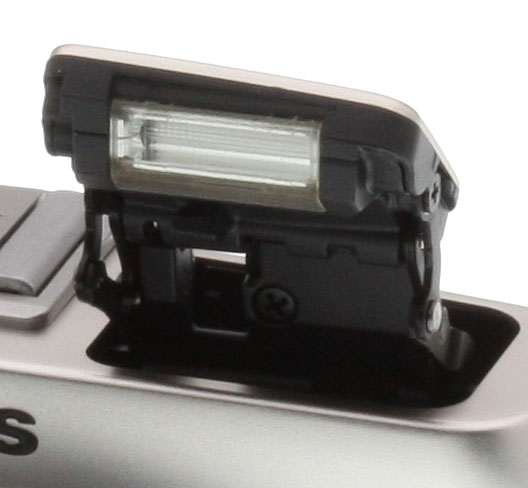
Flash. A built-in, pop-up flash strobe resides on the top panel of the Olympus E-P3, and has a guide number of 10 meters at ISO 200 equivalent. Flash exposures can be determined with TTL auto metering, or controlled manually at anywhere from 1/64 to full strength. The E-P3 also provides for external flash strobes courtesy of a hot shoe, but note that it is shared with the accessory port, so use of flash or accessories is an either / or proposition. The E-P3's hot shoe is compatible with the FL-50R, FL-36R, FL-50, FL-36, FL-20, FL-14, and FL-300R strobes. Flash sync is possible between 1/60 and 1/180 second, and the E-P3 also allows Super FP flash between 1/125 and 1/4,000 second, if supported by the attached flash. Flash exposure compensation is available within a range of +/- 3.0 EV, in 1/3, 1/2 or 1 EV steps. Finally, the E-P3 supports four-channel wireless flash with the built-in strobe acting as a master, and off-camera flash strobes configured in up to 3 groups.
Level Gauge. To help ensure level horizons and avoid converging verticals, the E-P3 includes a dual-axis electronic level gauge. This indicates both front-to-back pitch and side-to-side roll on the live view feed, ensuring your framing is straight and even.

Creative. Like past PEN-series models, the Olympus E-P3 includes a generous selection of pre-capture Art Filter functions, and all of these are applicable not only for still images, but also movie capture as well, although they may affect frame rate. Art Filters include Pop Art, Soft Focus, Pale & Color, Light Tone, Grainy Film, Pin Hole, Diorama, Gentle Sepia, Cross Process, and Dramatic Tone. There are also nine Art Filter variations and enhancements, including a new Pale & Light Color II filter, and five post capture Art Filter Effects, including new Star Light and White Edge filters. An Art Filter Bracketing function helps users to see the effect of different filters by saving multiple copies of each individual shot, with different filters applied. Further catering to creative types, the E-P3 also offers an in-camera Multiple Exposure function, a selection of different aspect ratios, and an in-camera editing function.
3D imaging. Olympus has included an interesting multi-shot 3D Photo mode in the E-P3, allowing in-camera creation of 3D images in the industry-standard Multi Picture Object (.MPO) format. MPO files contain multiple JPEG still images with slightly differing perspective, and can be viewed on some 3D-capable high-def displays. To capture a 3D image with the E-P3, you hold down the shutter button and slowly pan across the scene, until the camera automatically takes a second image with slightly differing perspective.
Video. As you'd expect these days, the Olympus E-P3 also provides for high definition video capture. The E-P3 offers recording at up to 1,920 x 1,080 pixel resolution (commonly known as Full HD, or 1,080i), with a rate of 60 interlaced fields per second. At Full HD resolution, videos are saved in AVCHD format with AC3 Dolby Digital audio. At 1,280 x 720 pixels (720p high definition), videos can be saved in either AVCHD or Motion JPEG AVI formats, with the latter including uncompressed 16-bit, 48kHz Linear PCM audio. Finally, 640 x 480 pixel (VGA standard definition) video is saved as Motion JPEG AVIs. Recording is initiated with a dedicated Direct HD video button.
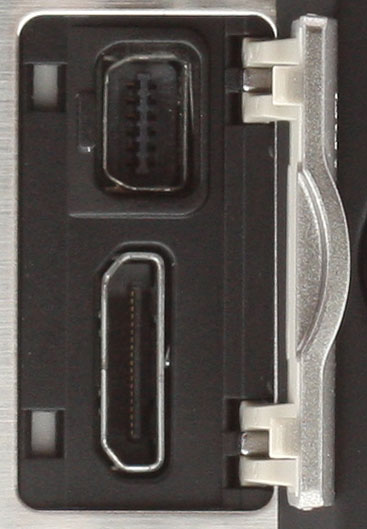
Ports. Combined USB/AV at top, Type-C Mini HDMI below.
Although the E-P3 provides image stabilization during movie capture, this is achieved in software, and the sensor shift stabilization system is disabled throughout. Unusually, the E-P3 allows not only Program exposure for movies, but also allows Aperture-priority, Shutter-priority, and Manual exposure, as well as use of its Art Filter functions. Shutter speeds in Shutter-priority or Manual modes are 1/30 second or less, and some Art Filter functions may adversely effect frame rate of recorded video.
Connectivity. The Olympus E-P3 includes USB 2.0 High Speed data connectivity, Type-C Mini HDMI high definition video output, and NTSC / PAL switchable composite standard definition video output with monaural audio. It's also compatible with Olympus' optional RM-UC1 USB remote control unit, which plugs into the combined USB/AV port. As mentioned previously, the E-PL3 allows for Bluetooth data transfer with the optional Olympus PENPAL accessory. Like other PEN models, no DC-input port is provided.
Olympus E-P3 Size Comparison
Olympus E-P3 vs E-P1
 |
 |
 |
|
Though clearly related, there are quite a few differences between the Olympus E-P3 and the original. The removable grip is inspired, if a little homely; thankfully it's removed easily enough. The new lens looks and is quite a bit lighter, much faster, silent, and lacks the lens lash problem we discovered in the original design. A new record button graces the back, and the pop-up flash necessitated the move of the Mode dial, which makes the E-P3 a little easier to use in the long run. We're happy they stuck with the unique Sub dial for zooming and controlling aperture while in Manual mode.
|