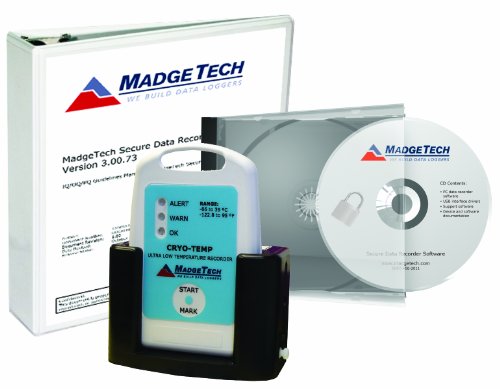
MADGETECH ULT90-15 ULTRA LOW FREEZER VALIDATION SYSTEM, WITH 15 CRYO-TEMP DATA LOGGERS, NIST CALIBRATION CERTIFICATES, IFC300 DOCKING STATION, FDA 21 CFR PART 11 SECURE SOFTWARE, AND IQ/OQ/PQ VALIDATION PROTOCOLS

FEATURES

  • NIST traceable calibration certificates, FDA 21 CFR Part 11 Compliant
  • IQ/OQ/PQ Validation protocols, splash proof Cryo-temp data logger
  • -86 degreeC to +35 degree C Temperature Range, 0.1 degree C Resolution and ±1.0 degree C Accuracy
  • 1 Year battery life at -80 degree C, user-programmable temperature alarms with LED's (ok, warn, and alarm)
  • Hardware and software password protection, memory wrap, user-programmable start times, sample intervals, logger descriptions, unique ID's

SPECIFICATION

Model No.ULT90-15
Package Dimension30.73 x 9.14 x 32.51 Cm
Package Weight2.36 ~ 2.83 Kg
Product GroupBISS
AvailabilityAvailable (Usually ships in 1-4 business days)

DESCRIPTION

MadgeTechs Ultra Low Temperature Freezer Validation System can measure and log data as low as -86 degreeC. It can be placed in small and large freezers of varying configurations. The system provides a complete stand-alone temperature mapping and validation solution for freezers to ensure uniform storage and testing conditions. The ULT90 includes a USB docking station with 6 feet of cable (IFC300), 15 Cryo-Temp data loggers with N.I.S.T. Calibration Certificates, and MadgeTechs FDA 21 CFR Part 11 Secure Software and IQ/OQ/PQ validation protocols. For larger freezers, loggers can be plotted in one graph to show variances in different parts of the freezer. Finally, as failure to monitor external freezer temperatures may invalidate internal freezer temperatures, an additional Cryo-Temp can be included for placement outside of the freezer. Note: the ULT90-9 is not compatible with 64 bit operating systems. The ULT90-15 is available with an extended warranty. Applications: ultralow freezer validation, ultralow freezer mapping, ultralow freezer stabilization studies, temperature surveys: reveal stratification of air, reveal hot spots, reveal anomalies in chilling systems.