
Description
1.1 Operates with ATmega328 microcontrollers.
1.2 Displaying the results to a 128x64 graphic LCD-Display.
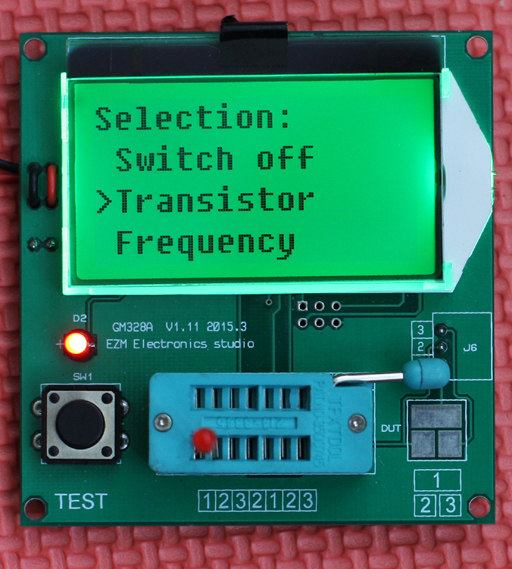
1.3 One key operation with automatic power shutdown.
1.4 Shutdown current is only about 20nA.
1.5 Automatic detection of NPN and PNP bipolar transistors, N- and P-Channel MOSFETs, JFETs,
diodes, double diodes, Thyristors and Triacs.
1.6 Automatic detection of pin layout of the detected part.
1.7 Measuring of current amplification factor and Base-Emitter threshold voltage of bipolar
transistors.
1.8 Darlington transistors can be identified by the threshold voltage and high current amplification
factor.
1.9 Detection of the protection diode of bipolar transistors and MOSFETs.
1.10 Measuring of the Gate threshold voltage and Gate capacity value of MOSFETs.
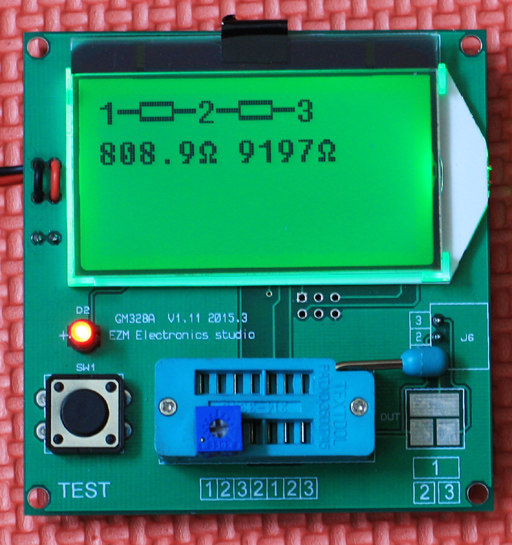
1.11 Up to two Resistors are measured and shown with symbols and values with up to four
decimal digits in the right dimension. All symbols are surrounded by the probe numbers of the
Tester (1-3). So Potentiometer can also be measured. If the Potentiometer is adjusted to one of
its ends, the Tester cannot differ the middle pin and the end pin.
1.12 Resolution of resistor measurement is now up to 0.01 Europe, values up to 50M Europe are detected.
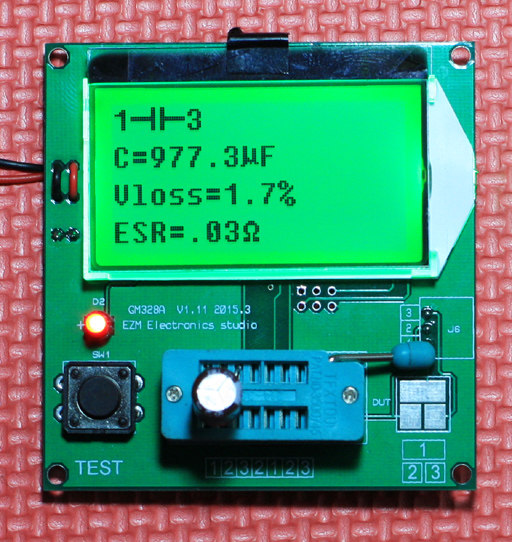
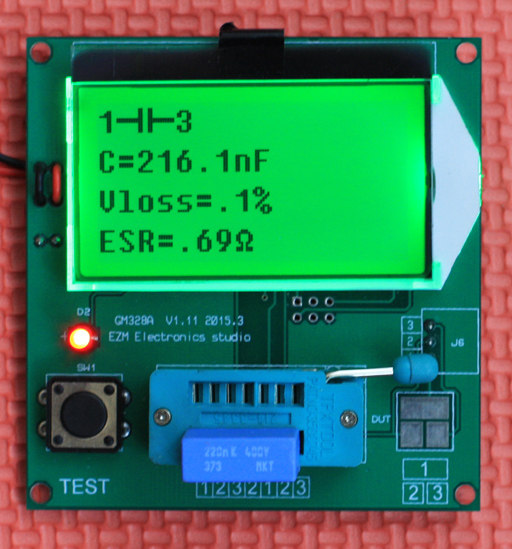
1.13 One capacitor can be detected and measured. It is shown with symbol and value with up to
four decimal digits in the right dimension. The value can be from 25pF to 100mF. The
resolution can be up to 1pF .
1.14 For capacitors with a capacity value above 0.18µF the Equivalent Serial Resistance (ESR) is
measured with a resolution of 0.01 Europe and is shown with two significant decimal digits.
1.15 For capacitors with a capacity value above 5000pF the voltage loss after a load pulse can be
determined. The voltage loss give a hint for the quality factor of the capacitor.
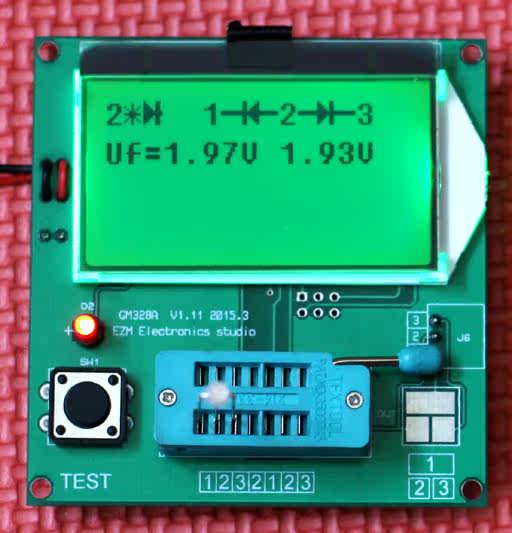
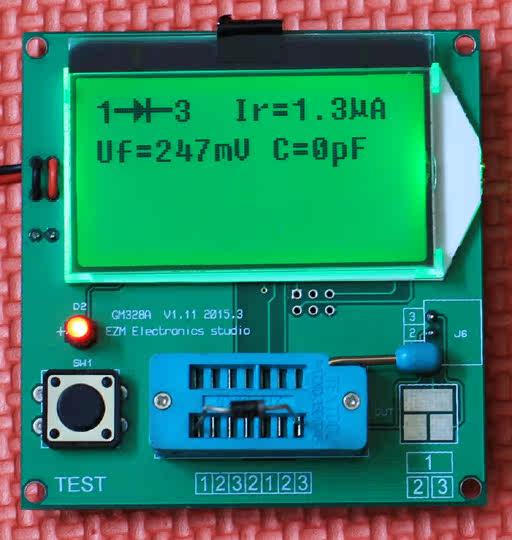
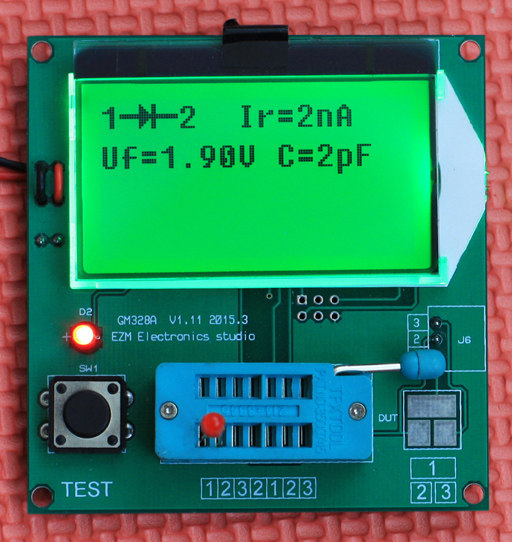
1.16 Up to two diodes are shown with symbol or symbol in correct order. Additionally the flux
voltages are shown.
1.17 LED is detected as diode, the flux voltage is much higher than normal. Two-in-one LEDs are
also detected as two diodes.
1.18 Zener-Diodes can be detected, if reverse break down Voltage is below 4.5V. These are shown
as two diodes, you can identify this part only by the voltages. The outer probe numbers, which
surround the diode symbols, are identical in this case. You can identify the real Anode of the
diode only by the one with break down (threshold) Voltage nearby 700mV!
1.19 If more than 3 diode type parts are detected, the number of founded diodes is shown
additionally to the fail message. This can only happen, if Diodes are attached to all three
probes and at least one is a Z-Diode. In this case you should only connect two probes and start
measurement again, one after the other.
1.20 Measurement of the capacity value of a single diode in reverse direction. Bipolar Transistors
can also be analysed, if you connect the Base and only one of Collector or Emitter.
1.21 Only one measurement is needed to find out the connections of a bridge rectifier.
1.22 Capacitors with value below 25pF are usually not detectet, but can be measured together with
a parallel diode or a parallel capacitor with at least 25pF. In this case you must subtract the
capacity value of the parallel connected part.
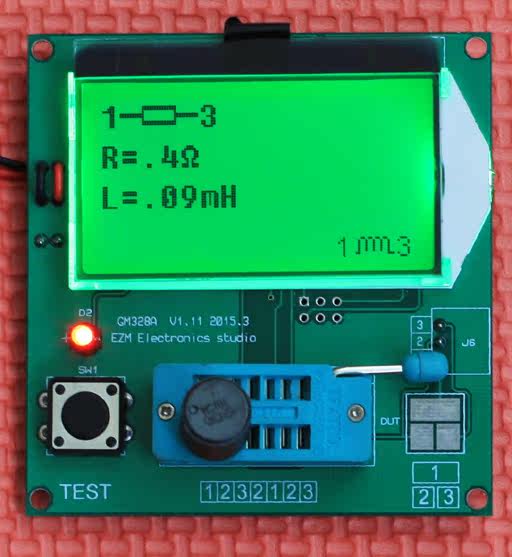
1.23 For resistors below 2100 Europe also the measurement of inductance will be done. The range will
be from about 0.01mH to more than 20H, but the accuracy is not good. The measurement
result is only shown with a single component connected.
1.24 Testing time is about two seconds, only capacity or inductance measurement can cause longer
period.
1.25 Software can be configured to enable series of measurements before power will be shut
down.
1.26 Selectable facility to calibrate the internal port resistance of port output and the zero offset of
capacity measurement with the selftest . A external capacitor with a value between 100nF and
20µF connected to pin 1 and pin 3 is necessary to compensate the offset voltage of the analog
comparator. This can reduce measurement errors of capacitors of up to 40µF. With the same
capacitor a correction voltage to the internal reference voltage is found to adjust the gain for
ADC measuring with the internal reference.
1.27 Display the Collector cutoff current ICE0 with currentless base (10µA units) and Collector
residual current ICES with base hold to emitter level . This values are only shown, if they are
not zero (especially for Germanium transistors).
1.28 Thyristors and Triacs can only be detected, if the test current is above the holding current.
Some Thyristors and Triacs need as higher gate trigger current, than this Tester can deliver.
The available testing current is only about 6mA!
Attention: Allways be shure to discharge capacitors before connecting them to the Tester! The
Tester may be damaged before you have switched it on. There is only a little protection at the
ATmega ports.
Extra causion is required if you try to test components mounted in a circuit. In either case the
equipment should be disconnected from power source and you should be shure, that no residual
voltage remains in the equipment.