Product Description
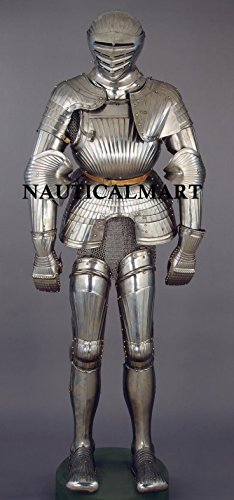
It's called Maximilian because it was developed right through the era when Maximilian was the Holy Roman Emperor. He became Emperor in 1508 and died in 1519. The heavily fluted style of armour such as the example you cited was developed exactly during that time period. The transitional era from Gothic to Maximilian was approximately between 1495-1505, where elements of the robust, Milanese harnesses began to be incorporated into German harnesses. By 1505 there are numerous examples of fluted armours that resemble the Maximilian style more than Gothic, and by 1515-1520 we have quite a few full harness examples. The pinnacle of the style was around 1520, and it continued to evolve until the 1540s, but these newer characteristics were not specifically what we today consider "Maximilian," and were rather the incorporation of other details into the Maximilian armours. It is also important to note that although full harnesses in the heavily-fluted Maximilian style did not appear until the emperor was nearly on his death bed, the heavily fluted armour itself was already extremely popular among soldiers such as landsknechts, who often wore cuirass and tassets to battle. The emperor was the father of these soldiers, in his eyes and the eyes of the empire, and it is suitable, I think, to use his name for the hugely popular and flamboyant style of fluted armour that appeared during his reign in whatever form. Perhaps, in correlation to the full harnesses, there can be some dissent over whether or not his name is applied well... But in the scheme of things, the changing of German military tactics and his waves of reform, the evolutionary jump in armour stylization (leading right out of a transitional era) and the wars fought during the period leave us undeniably looking for something to tack his name onto. I think the armour hit the nail on the head.
0
|