|
Description
High Quality Premium Package
- 380 ml
- Honey Softening Shower Cream
- Enriched vitamin E
- Rich with the nurturing of values
- Adds moisture and elasticity to the skin
Cream, honey, soft skin. "Cream ice cream soft skin deep. Value with the maintenance of natural honey (Honey Extract), which is rich in B vitamins (Vitamin B) and protein in the skin of valuable moisture is also rich in value of maintenance. Extracts of cucumber (Cucumber Extract) feature. Adds moisture and elasticity to the skin, extracts of aloe vera (Aloe vera Extract) helps protect the skin from the fat, milk protein (Hydrolyzed Milk Protein improves the skin. And add flexibility to the skin radiant healthy.

|
Manufactured :Beauty Buffet
|
|
Size : 3 Packs of 380ml/Box
|
|
Condition : Brand new & Never used with a seal pack.
|
|
|
Aloe vera has been used for a host of purposes since the ancient Egyptians called it the “plant of immortality.” Since then, its uses have become more targeted and medicinal, and it's one of the leading therapies for sunburns. Aloe vera is a cactus plant that belongs to the Liliaceae family. It grows in dry climates such as those found in parts of Africa and India and has been used medicinally for centuries. Aloe leaves secrete a clear gel that when broken off from the rest of the plant that can be applied topically to heal wounds and soothe skin. Various studies have been conducted to examine the benefits of the aloe vera plant and it was found out that aloe vera does in fact have several properties that are effective in treating a variety of skin conditions, from flaky or dry skin, cosmetic ailments, hair and scalp problems to many more. It is also said to be useful in treating wounds and burns, minor skin infections, cysts, diabetes, and elevated blood lipids in humans, and shows some promise in treating more serious and persistent conditions such as eczema, genital herpes, dandruff, psoriasis, canker sores, skin ulcers and others, according to the Mayo Clinic.
Here are 8 benefits of using aloe vera gel:
1. It treats sunburn.
Aloe Vera helps with sunburn through its powerful healing activity at the epithelial level of the skin, a layer of cells that cover the body. It acts as a protective layer on the skin and helps replenish its moisture. Because of its nutritional qualities and antioxidant properties, the skin heals quicker. 2. It acts as a moisturizer.
Aloe moisturizes the skin without giving it a greasy feel, so it`s perfect for anyone with an oily skin complexion. For women who use mineral-based make-up, aloe vera acts as a moisturizer and is great for the face prior to the application to prevents skin drying. For men: Aloe vera gel can be used as an aftershave treatment as its healing properties can treat small cuts caused by shaving.
3. It treats acne.
Aloe vera gel contains two hormones: Auxin and Gibberellins. These two hormones provide wound healing and anti-inflammatory properties that reduce skin inflammation. Giberellin in aloe vera acts as a growth hormone stimulating the growth of new cells. It allows the skin to heal quickly and naturally with minimal scarring.
Aloe is soothing and can reduce skin inflammations, blistering and itchiness, while helping the skin to heal more rapidly. Additionally, in Ayurvedic medicine, Aloe is used to effectively heal chronic skin problems, such as psoriasis, acne and eczema. 4. It fights aging.
As we age, everyone begins to worry about the appearance of fine lines and the loss of elasticity in their skin. Aloe leaves contain a plethora of antioxidants including, beta carotene, vitamin C and E that can help improve the skin's natural firmness and keep the skin hydrated.
5. It lessens the visibility of stretch marks.
The skin is like one big piece of elastic that’ll expand and contract as needed to accommodate growth. But if the skin stretches too far, too fast (due to pregnancy, rapid weight gain or loss) the elasticity of the skin can be damaged. That’s what leaves those unsightly stretch marks. These marks appear due to minor tears in the layers of the skin caused by sudden and excessive stretching. Aloe vera gel can help hide these stretch marks by healing these wounds. 6. It's nutrient rich for good health.
This solid material contains over 75 different nutrients including vitamins, minerals, enzymes, sugars, anthraquinones or phenolic compounds, lignin, saponins, sterols, amino acids and salicylic acid. 7. It soothes in periodontal disease.
According to a study published in the Journal of Ethnopharmacology, it's extremely helpful in the treatment of gum diseases like gingivitis, periodontitis. It reduces bleeding, inflammation and swelling of the gums. It is a powerful antiseptic in pockets where normal cleaning is difficult, and its antifungal properties help greatly in the problem of denture stomatitis, apthous ulcers, cracked and split corners of the mouth. 8. It aids in digestion.
The internal benefits of aloe vera are supposed to be just as amazing. The plant is said to improve the digestion and to relieve ulcers. Some people consider it a laxative, while others attribute that effect to its digestive qualities (which normalize the system and induce regularity). The juice is also prescribed for arthritis and rheumatism. To test any of these claims, steep the cut foliage in water or chew pieces of the fresh leaf.
|
Moisturizing effect of cosmetic formulations containing Aloe vera extract in different concentrations assessed by skin bioengineering techniques Susi Elaine Dal'Belo, Lorena Rigo Gaspar and Patrícia Maria Berardo Gonçalves Maia Campos Article first published online: 5 OCT 2006DOI: 10.1111/j.0909-752X.2006.00155.x
Background/purpose: The polysaccharide-rich composition of Aloe vera extracts (Aloe barbadensis Miller), often used in cosmetic formulations, may impart moisturizing properties to the product. The aim of this study was to evaluate the effect of cosmetic formulations containing different concentrations of freeze-dried Aloe vera extract on skin hydration, after a single and a 1- and 2-week period of application, by using skin bioengineering techniques.
Methods: Stable formulations containing 5% (w/w) of a trilaureth-4 phosphate-based blend were supplemented with 0.10%, 0.25% or 0.50% (w/w) of freeze-dried Aloe vera extract and applied to the volar forearm of 20 female subjects. Skin conditions in terms of the water content of the stratum corneum and of transepidermal water loss (TEWL) (CorneometerTM CM 825 and TewameterTM TM 210) were analysed before and after a single and 1- and 2-week period of daily application.
Results: After a single application, only formulations supplemented with 0.25% and 0.50% (w/w) of Aloe vera extract increased the water content of the stratum corneum, while after the 2-week period application, all formulations containing the extract (0.10%, 0.25% and 0.50%) had the same effect, in both cases as compared with the vehicle. TEWL was not modified after a single and after 1- and 2-week period of application, when compared with the vehicle.
Conclusion: Our results show that freeze-dried Aloe vera extract is a natural effective ingredient for improving skin hydration, possibly through a humectant mechanism. Consequently, it may be used in moisturizing cosmetic formulations and also as a complement in the treatment of dry skin.
|
|
|
Aloe vera leaf gel: a review update T Reynoldsa, A.C Dweckb doi:10.1016/S0378-8741(99)00085-9
Abstract Research since the 1986 review has largely upheld the therapeutic claims made in the earlier papers and indeed extended them into other areas. Treatment of inflammation is still the key effect for most types of healing but it is now realized that this is a complex process and that many of its constituent processes may be addressed in different ways by different gel components. A common theme running though much recent research is the immunomodulatory properties of the gel polysaccharides, especially the acetylated mannans from Aloe vera, which are now a proprietary substance covered by many patents. There have also been, however, persistent reports of active glycoprotein fractions from both Aloe vera and Aloe arborescens. There are also cautionary investigations warning of possible allergic effects on some patients. Reports also describe antidiabetic, anticancer and antibiotic activities, so we may expect to see a widening use of aloe gel. Several reputable suppliers produce a stabilized aloe gel for use as itself or in formulations and there may be moves towards isolating and eventually providing verified active ingredients in dosable quantities
|
|
|
Composition and Applications of Aloe vera Leaf Gel Josias H. Hamman Molecules 2008, 13(8), 1599-1616; doi:10.3390/molecules13081599
Abstract Many of the health benefits associated with Aloe vera have been attributed to the polysaccharides contained in the gel of the leaves. These biological activities include promotion of wound healing, antifungal activity, hypoglycemic or antidiabetic effects antiinflammatory, anticancer, immunomodulatory and gastroprotective properties. While the known biological activities of A. vera will be briefly discussed, it is the aim of this review to further highlight recently discovered effects and applications of the leaf gel. These effects include the potential of whole leaf or inner fillet gel liquid preparations of A. vera to enhance the intestinal absorption and bioavailability of co-administered compounds as well as enhancement of skin permeation. In addition, important pharmaceutical applications such as the use of the dried A. vera gel powder as an excipient in sustained release pharmaceutical dosage forms will be outlined.
|
|
Cucumber is a very edible fruit which comes from the cucumber plant cucumis sativus, which is part of the gourd family. It is being used for different purpose as it can be eaten raw or cooked. With so many health benefits it becomes one of the most important parts of food diet as well as skin diet.
Your skin has many other purposes other than being beautiful and serving as an eye candy for everyone. It protects our internal organs from any of the external adversities as far as possible.First a little Information about Cucumbers
Types of cucumber include:
Dosakai - A cucumber that is yellow in color, has a round shape and is available in many parts of India. Commonly added in Chutney, Sambar or Soup, Daal and also in making Dosa-Aavakaaya (a type of Indian Pickle).
English cucumbers - Have very little in the way of seeds and can grow to around 2 feet in length.
Mediterranean cucumbers - Skins are smooth with nearly seedless flesh, they have a mild taste.
Japanese cucumbers or kyuri - A dark green cucumber with a very bumpy skin. Mainly used for slicing, salads and pickling.
Cucumber is a very edible fruit which comes from the cucumber plant cucumis sativus, which is part of the gourd family. It is being used for different purpose as it can be eaten raw or cooked. With so many health benefits it becomes one of the most important parts of food diet as well as skin diet. In North America, the term "wild cucumber" refers to manroot.
Cucumber can claim to be a water body as it has 90% water. It is known to be a cooling agent due to the water in it.
Cucumber for Eyes
It is believed that cucumber helps in reducing swelling around the eyes or the big dark circles under your eyes. This is world-wide treatment which is being used to its maximum extent.Cucumbers are the most wonderful and natural eye pads you can find for yourself. The puffiness and the tiredness in your eyes may just leave you, if you do this in a relaxed fashion. These natural eye pads do wonders after a long days work.
Cucumber for Skin
If you want a happy skin, then cucumber is the answer. As cucumber and the skin share the same level of hydrogen, it becomes easier for cucumber to mask all the problem areas. It helps in soothing and softening your skin which can get you relaxed in no time.With so many useful ingredients in cucumber it can help you in treating so many skin problems. It has become part of daily beauty product into face packs, facials, juice and many other things which can affect your skin.Due to its cooling effect it can be termed as a magic wand for all your skin problems. The cleaning and cleansing property helps your skin tremendously making it soft and supple.The regular intake of cucumber juice is very useful both internally and externally.
To have a healthy glowing and smooth skin use this recipe. Blend 4 - 5 leafs of fresh mint.Peel and de-seed the cucumber.Add mint leaves to the cucumber to make a puree.Beat egg white and keep it separate, then add this egg white to the cucumber mixture.Apply this evenly on your face for 20 minutes and then rinse it with water and pat it dry.
|
Tyrosinase Inhibitory Activity of Cucumber Compounds: Enzymes Responsible for Browning in Cucumber Fernando Gandía-Herrero , Mercedes Jiménez , Juana Cabanes , Francisco García-Carmona , and Josefa Escribano * Departamento de Bioquímica y Biología Molecular A, Unidad Docente de Biología, Facultad de Veterinaria, Universidad de Murcia, E-30100 Espinardo, Murcia, Spain
Abstract The inhibition of mushroom tyrosinase by cucumber extracts was evaluated. The inhibitory effect was measured by both polarographic and spectrophotometric methods. The commercial aldehyde, trans,cis-2,6-nonadienal, described as a major volatile compound of cucumber, was characterized as a noncompetitive inhibitor against 4-tert-butylcatechol oxidation by mushroom tyrosinase. The KI obtained was 3.4 mM. Polyphenol oxidase (PPO) activity was not detected in cucumber skin extracts. However, the presence of PPO was revealed by Western blot; a single band was found with a Mr of 53 kDa. These results support the assumption that the enzyme PPO is present in the cucumber skin, but its activity is inhibited. Peroxidase (PO) was also found in cucumber skin extracts. This enzyme was detected in the soluble fraction but not in the membrane fraction. The kinetic characterization of PO was carried out. Native isoelectric focusing revealed several acidic PO isoenzymes with a pI in the range between 5 and 6, a basic isoenzyme, and one principal neutral isoenzyme of pI = 7.2.
|
|
|
Phytochemical and therapeutic potential of cucumber Pulok K. Mukherjeea, Neelesh K. Nemaa, Niladri Maitya, Birendra K. Sarkarb* doi:10.1016/j.fitote.2012.10.003
Abstract
Cucumber (Cucumis sativus L.) is a member of the Cucurbitaceae family like melon, squash and pumpkins. It is a popular vegetable crop used in Indian traditional medicine since ancient times. This vegetable is very high in water content and very low in calories. It has potential antidiabetic, lipid lowering and antioxidant activity. Cucumber has a cleansing action within the body by removing accumulated pockets of old waste materials and chemical toxins. Fresh fruit juice is used for nourishing the skin. It gives a soothing effect against skin irritations and reduces swelling. Cucumber also has the power to relax and alleviate the sunburn's pain. The fruit is refrigerant, haemostatic, tonic and useful in hyperdipsia, thermoplegia etc. The seeds also have a cooling effect on the body and they are used to prevent constipation. Several bioactive compounds have been isolated from cucumber including cucurbitacins, cucumegastigmanes I and II, cucumerin A and B, vitexin, orientin, isoscoparin 2″-O-(6‴-(E)-p-coumaroyl) glucoside, apigenin 7-O-(6″-O-p-coumaroylglucoside) etc. Despite huge exploration of cucumber in agricultural field, comparatively very few studies have been published about its chemical profile and its therapeutic potential. This article reviews the therapeutic application, pharmacological and phytochemical profile of different parts of C. sativus. In this review we have explored the current phytochemical and pharmacological knowledge available with this well known plant and several promising aspects for research on cucumber.
|
|
Honey /ˈhʌni/ is a sweet food made by bees using nectar from flowers. The variety produced by honey bees (the genus Apis) is the one most commonly referred to, as it is the type of honey collected by most beekeepers and consumed by people. Honeys produced by other bees (bumblebees, stingless bees) and other hymenoptera insects (e. g. honey wasps) have different properties, and are discussed only briefly in this article.Honey bees transform nectar into honey by a process of regurgitation and evaporation. They store it as a primary food source in wax honeycombs inside the beehive.Honey gets its sweetness from the monosaccharides fructose and glucose, and has approximately the same relative sweetness as granulated sugar. It has attractive chemical properties for baking and a distinctive flavor that leads some people to prefer it over sugar and other sweeteners.Most microorganisms do not grow in honey because of its low water activity of 0.6.
However, honey sometimes contains dormant endospores of the bacterium Clostridium botulinum, which can be dangerous to infants, as the endospores can transform into toxin-producing bacteria in infants' immature intestinal tracts, leading to illness and even death.Honey has had a long history in human consumption, and is used in various foods and beverages as a sweetener and flavoring. It also has a role in religion and symbolism. Flavors of honey vary based on the nectar source, and various types and grades of honey are available. It has also been used in various medicinal traditions to treat ailments. The study of pollens and spores in honey (melissopalynology) can determine floral sources of honey.[5] Bees carry an electrostatic charge whereby they attract other particles in addition to pollen, which become incorporated into their honey; honey can be analysed by the technique of melissopalynology, in the area of environmental studies of radioactive particles, dust and particulate pollution
|
THE B VITAMINS IN HONEY1GEORGE KITZES, H. A. SCHUETTE, AND G. A. ELVEHJEM Departments of Chemistry ana Biochemistry, University of Wisconsin, Madison(Eeceived for publication March 25, 1943) Honey is a widely used food an undoubtedly due to itssweetness, pleasant taste and aroma. Since honey is a naturalsubstance and is food for the honeybee, there has been muchspeculation as to its value in the nutrition of man. Honey isprepared from the nectar of flowers by worker bees and storedin the honeycomb. Although honey is derived primarily fromnectaries of flowers, we cannot overlook the part the honeybeeplays in storing the nectar in the hive and in processing it toits final form. Thus honey should be considered the productof the bee processed from a plant product.The analysis of honey has shown that it consists of approximately 75-80% sugar, mainly invert sugar, which is a conversion product of sucrose.
Schuette et al. ( '32, '37, '38, '39)have shown the presence of mineral elements in honey. Notableamong these are iron, copper, sodium, potassium, manganese,calcium, magnesium, and phosphorus, all of which have beenshown to be essential to good nutrition of animals. Since honeyis basically derived from the flower and moreover is a food forthe bee, much speculation has arisen as to its vitamin content,especially because great emphasis has been placed on the importance of vitamins in human nutrition. It seems that thisproblem has interested workers for two decades, many ofwhom have reported the absence of vitamins A, B, C, D, and E1Published with the approval of the Director of the Wisconsin Agricultural Experiment Station. Supported in part by a grant from the American Honey Institute.The authors are indebted to Dr. Frank M. Strong for valuable suggestions regarding the microbiological assays in honey.
These results may be interpreted in the light of themethods employed, which have been much improved in recentyears.Recently chemical determinations of vitamin C in honeyhave been made by Griebel ('38). He reported 160-280 mg.ascorbic acid per 100 gm. of mint honey and 7-22 mg. per 100gm. of other honeys. Griebel and Hess ( '39) identified thestrong reducing substance in thyme and mint honeys as ascorbic acid. They reported 311.2 mg. and 102.6 mg. of thisvitamin per 100 gm. of the respective honeys. Buckwheathoneys contained from 7.36-18.6 mg. ascorbic acid per 100 gm.They (Griebel and Hess, '40) determined also the ascorbicacid content of the nectar of the above plants. It was shownthat there is a considerable loss of vitamin C when nectar isconverted into honey. Schuette and Kaye ( '42) investigateda series of honeys and found 0.55-20.9 mg. of vitamin C per100 gm. The degree of destruction of vitamin C in honey wasalso studied. It was noted that there was a decrease in thetotal ascorbic acid content of honey after pure ascorbic acidwas added. The loss was greatly increased in the honeys placedin diffused light.Hay dak and Palmer ( '42 a) reported the vitamin contentof honeys of varied nectar source and origin. They reportedthe following values per 100 gm. of honey : thiamine,2.1-9.1 Mg-; riboflavin, 35-145 Mg-; pyridoxine, 210-480 Mg.;pantothenic acid, 25-192 Mg.; nicotinic acid, 4-94 mg. ; ascorbicacid, 0.6-5.4 mg.
The authors of this paper will attempt to give a clear picture of the vitamins in honey obtained by the improvedmethods of vitamin assay. These include the more recentmichrochemical and microbiological methods, some of whichhave been modified in the University of Wisconsin. Preliminary investigations did not reveal the presence of the fat-soluble vitamins ; therefore only the contents of water-solublevitamins were determined. Together with numerous samplesof honey we have analyzed pollen and royal jelly, two naturalsubstances also serving as food for bees Riboflavin was determined by the microbiological methodof Snell and Strong ( '39). Preparation of the sample was asfollows : 25 gm. of honey were diluted to 75 ml. with distilledwater and autoclaved for 15 minutes at 15 pounds pressure.The use of acid was avoided for the reasons explained for thenicotinic assay. Enzyme digestion with clarase did not alterthe value significantly. It should be mentioned that the naturalpH range of honey is 4-5 ; therefore the honey dilution wasacid during the autoclaving, thereby reducing any possibledestruction of the riboflavin. Ether extraction of the honeydilution did not remove any stimulatory or inhibitorysubstances.Thiamine was determined by the Hennessy-Cerecedo thio-chrome method as modified by the Research Corporation Committee on the Thiochrome Method (Hennessy, '42).
A Colemanphotofluorometer was used to measure the fluorescence of thethiochrome produced by the oxidation of the thiamine. Thisinstrument can accurately determine 0.02 pg- of thiamine.Recovery of added thiamine ranged from 85% to 105%. Valuesare expressed in micrograms of thiamine-hydrochloride.Pyridoxine was determined by the microbiological methodof Atkin, Schultz, Williams, and Frey ('43). In this methodthe response of a strain of yeast to pyridoxine is measuredby turbidity readings. The range of sensitivity of the assayis 5 to 40 mpg. Enzyme digestion was used to release any boundpyridoxine. Recovery of added pyridoxine ranged from 95%to 105%. Values are expressed in micrograms of pyridoxine-hydrochloride per 100 gm.Biotin was determined by the microbiological method ofSnell, Eakin, and Williams ('40), using yeast and measuringthe growth of the organism by turbidity readings. The assayswere conducted by Miss Josephine Gardner of the Biochemistry Department of the University of Wisconsin.Folie acid was determined by the method of Mitchell andSnell ('41), using the streptococcus lactis organism. The assays were conducted by Mr. T. D. Luckey of the BiochemistryDepartment of the University of 7isconsin.
The folie acid values are expressed in this paper as micrograms of folie acidbased on a solubilized liver standard with a potency of 40,000.The samples of pollen which were analyzed were obtainedfrom Professor Farrar of the Department of Economic Entomology of the University of Wisconsin. One sample ofpollen was a mixture from an area around Madison, Wisconsin. The other sample was a mixture of pollen from BatonRouge, Louisiana. The sample of royal jelly was obtained ina dry form from Dr. H. B. Parks of the Texas AgriculturalExperiment Station.
RESULTS AND DISCUSSION
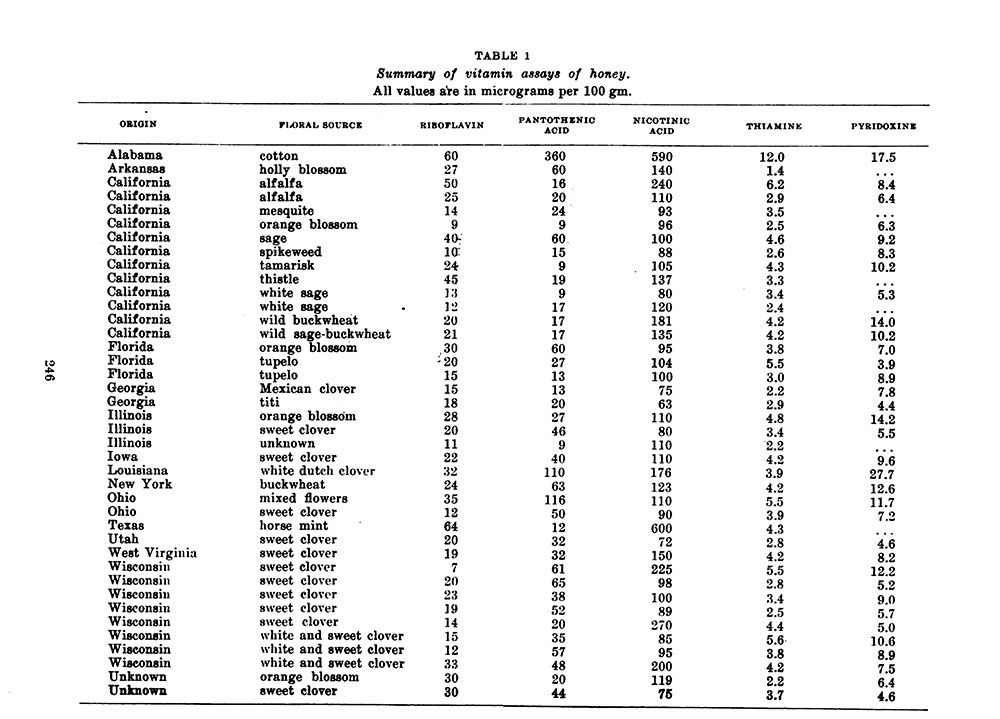
Table 1 gives the results of analyses of forty samples ofhoneys from different regions of the United States. Althoughthe source of the honey is also listed, it is understood thathoney is usually a mixture of nectars. The floral source listed,however, is the predominant one. An examination of the values obtained for the five members of the B-complex showedgreat variation among the samples. The greatest variationwas in the nicotinic acid content. In one instance, a sampleof honey contained nine times as much nicotinic acid as another. The least variation occurred in -the thiamine and pyridoxinevalues, but even here the variation was as much asfivefold. An attempt was made to correlate the vitamin content with floral source, origin, and color-grade.This provedfruitless for we did not have a sufficiently large number ofsamples of honey of one locality to enable us to say that oneset of data is typical of that source. The wide variation ofthe vitamin contents precluded any attempt to correlate thevalues with the color-grade of the honeys.

Table 2 presents a summary of the vitamin content of thehoneys examined. It also shows the differences in the vitamincontent of the old honeys as compared with the new samples.In the course of the investigation for pantothenic acid, it became apparent that the pantothenic acid values for a largenumber of honeys were lower than those of the rest. It wasfound that the group of honeys that had been obtained from the Chemistry Department contained 50% less pantothenicacid than those received from various beekeepers. The formerwere of the crops of 1935-1939 and had been stored in a darkcloset at room temperature. The honeys obtained this yearwere of the crops of 1940-1942. Many of these samples werereceived in the comb; others had been extracted before shipment. The difference in the pantothenic acid content of thesetwo groups may be explained by the fact that this vitamin isunstable in an acid solution. Honey is naturally acid, havinga pH range of 4-5. This acidity is not very great, but any pantothenic acid that might be in the honey could be destroyedslowly over a period of years. This is of little significance tothe beekeeper or the housewife who do not keep honey for longperiods of time.A few honey samples were analyzed for their biotin andfolie acid content, two new members of the B-complex whoseimportance in nutrition is being investigated. Traces of biotinand folie acid wore found, with the average values of 0.066 Mg.and 3 Mg.per 100 gm., respectively. Since the amounts foundwere very small as compared to other foods, we did not examinemany honeys.

Table 3 presents a comparison of the vitamin content of thesamples of honey of the years 1940-1942 with pollen and royaljelly. It may be noted that the royal jelly, a milky-white sub-stance secreted by the worker bee is unusually high in pantothenicacid and biotin. This may be related to the rapid metabolism in the young bee larvae which depend on this substancefor sustenance the first 3 days after emergence from the egg.Comparison of the vitamin content of pollen with that of honeyrevealed that in general pollen was a hundred times richer inthe B vitamins than honey. This suggested that the vitaminsin the honey may be due partially to the pollen present in eachsample. All natural honeys contain a certain amount of pollen,which at times is very small in quantity. Haydak and Palmer('42a) have found that a commercial process of clarifying honey reduces the vitamin contents 33-50% of the originalvalues. When we filtered diluted honey, through Whatmanno. 40 filter paper subsequent to its preparation for assay, wefound that the riboflavin content was reduced 40% and the nicotinicacid values 25%. It is suggested that the large variationin the vitamin content of the honeys may be due in part to thevariable amount of pollen present.The values reported in this publication compare favorablywith those of other workers. Pearson ( '42) reports an average value of 30.3 ig. of pantothenic acid per gram of pollenand 511 pg. per gram (dry weight) of royal jelly. Cheldelinand Williams ( '42) have analyzed royal jelly for the vitaminsof the B complex. We find that our results agree very wellwith those of the Texas workers. Haydak and Palmer ('42b)report that chemical determinations did not show even tracesof pyridoxine either in bee bread or royal jelly. The valuesthey obtained for the amount of nicotinic acid and pyridoxinefound in honey are many times higher than our results. Thediscrepancy is so great that it is believed to be due to themethods of analyses employed. It is significant to note thatHaydak and Palmer used chemical methods for both the nicotinic acid and pyridoxine determinations. It is probable thatthe treatment of the honey sample necessary to free the vitamins gave rise to interfering substances.

SUMMARY Microchemical and microbiological determinations showedthe presence in honey of thiamine, riboflavin, nicotinic acid,pantothenic acid, pyridoxine, biotin, and folie acid. The variation among samples was very large, due perhaps to the sourceof the honey and the number of pollen grains present. Comparison of new and aged honeys revealed a decrease in thepantothenic acid content of the latter. Pollen and royal jellyhave also been assayed for these vitamins and have been foundto be good sources of the B-complex. Royal jelly is very richin biotin and pantothenic acid, which may be significant in themetabolism of the young bee.
LITERATURECITED ATKIN, L., A. S. SCHULTZ,W. L. WILLIAMSANDC. N. FREY 1943 Yeast micro biological method for the determination of pyridoxine. Ind. and Eng. Chem. (anal.), vol. 15, p. 141. CHELDELIN,V. H., ANDR. J. WILLIAMS 1942 The B vitamin content of foods. The University of Texas Publication No. 4237, p. 105. GRIEBELC. 1938 Vitamin C-enthaltende Honige. Ztschr. Untersuch. Lebensm., vol. 75, p. 417. GBIEBEL,C., ANDG. HESS 1939 Vitamin C-enthaltende Honige. Ztschr. Unter such. Lebensm., vol. 78, p. 308. 1940 Der C-Vitamingehalt des Blutennecktars bestimmter Labiaten. Ztschr. Untersuch. Lebensm., vol. 79, p. 168. HAYDAK,M. H., ANDL. S. PALMER 1942 a Vitamin content of honeys. 'J. Nutrition, vol. 23, p. 581. 1942 b Royal jelly and bee bread as sources of vitamins B C, nicotinic acid and pantothenic acid. J. Econ. Entom., vol. 35, p. 319. HENNESSY,D. J. 1942 The determination of thiamin in cereal products. "Cereal Chemists Bull. ' ', vol. 2. Downloaded from jn.nutrition.org by guest on December 13, 2014 250 GEORGE KITZES AND OTHERS SCHUETTE,H. A., ANDD. J. HuENiNK 1937 Mineral constituents of honey. II. Phosphorus, calcium, magnesium. Food Research, vol. 2, p. 529. SCHUETTE,H. A., ANDF. KATE 1942 Master's Thesis. Univ. Wisconsin. Unpublished. SCHUETTE,H. A., AND KATHOKAREMY 1932 Degree of pigmentation and its probable relationship to the mineral constituents of honey. J. Am. Chem. Soe., vol. 54, p. 2909. SCHUETTE,H. A., ANDR. E. TRILLER 1938 Mineral constituents of honey. III. Sulfur and chlorine. Food Research, vol. 3, p. 543. SCHUETTE,H. A., ANDW. W. WOESSNER 1939 Mineral constituents of honey. IV. Sodium and potassium. Food Research, vol. 4, p. 349. SNELL, E. E., R. E. EAKIN ANDR. J. WILLIAMS 1940 A microbiological method for the determination of biotin. J. Am. Chem. Soc., vol. 62, p. 175. SNELL,E. E., ANDF. M. STRONO 1939 A microbiological assay for riboflavin. J. Ind. Eng. Chem. (anal.), vol. 11, p. 346. SNELL, E. E., ANDL. D. WRIGHT 1941 A microbiological method for the deter mination of nicotinic acid. J. Biol. Chem., vol. 139, p. 625. STRONG,F. M., R. E. FEENET ANDA. EARLE 1941 Microbiological assay for pantothenic acid. J. Ind. Eng. Chem. (anal.), vol. 13, p. 566.
|
|
During 2-3 years, Beauty Buffet is rising to the most popular cosmetics brand in Thailand. They are running the business under the world technology production. The company has passed the standard certification: GMP, ISO9001:2000 and ISO17025 (IEC GUIDE25) .They makes the store like the buffer restaurant that everybody can choose their many products like buffet foods. This concept help customer more comfortable and easier for collect to their style. Now, Beauty Buffet has many shop branchs in all of Megastore in Thailand (Tesco lotus, Makro).


|