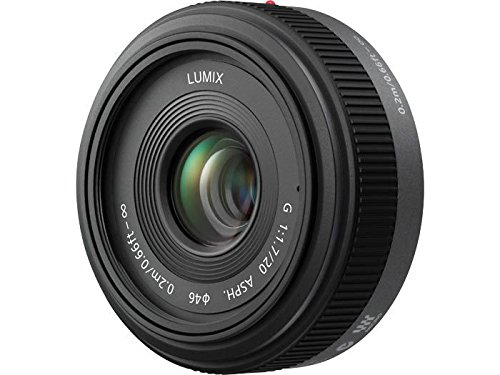
| Date introduced | September 2009 |
|---|---|
| Maximum format size | Micro Four Thirds |
| Focal length | 20mm |
| 35mm equivalent focal length | 40mm |
| Diagonal angle of view | 57° |
| Maximum aperture | F1.7 |
| Minimum aperture | F16 |
| Lens Construction | • 7 elements/ 5 groups • 2 Aspherical elements |
| Number of diaphragm blades | 7, rounded |
| Minimum focus | 0.2m / 0.66ft |
| Maximum magnification | Approx 0.13x |
| AF motor type | DC Micro motor |
| Focus method | Unit focus |
| Image stabilization | No |
| Filter thread | • 46mm • Does not rotate on focus |
| Supplied accessories* | • Front and rear caps • Lens case |
| Weight | 100g (3.5 oz) |
| Dimensions | 63mm diameter x 25.5mm length (2.5 x 1.0 in) |
| Lens Mount | Micro Four Thirds |
The Panasonic 20mm F1.7 pancake does rather well in our studio tests. Distortion is being corrected in software, as is lateral chromatic aberration when used on Panasonic camera bodies (although not on the Olympus E-P1), and this is reflected in the results for these tests. Compared to the Olympus M Zuiko Digital 17mm F2.8, the Panasonic simply shines - it's much sharper (to the extent of being better at F1.7 than the Olympus is at F2.8), and has lower CA (even before software correction), less falloff and lower distortion (both 'native' and corrected). Overall very impressive results for a lens this small.
| Sharpness | Sharpness results are extremely good; the lens is very sharp in the center even wide open, and while the corners are somewhat soft at F1.7, they sharpen up rapidly on stopping down. Optimum results are obtained between F2.8 and F6.3; stopping down further sees sharpness progressively fall due to diffraction (mercifully Panasonic doesn't provide apertures smaller than F16). Comparison of results obtained using the Panasonic G1 and Olympus E-P1 show slightly better results on the former - the gradual attenuation of MTFs by the E-P1 at higher frequencies indicates a slightly stronger low-pass filter. |
|---|---|
| Chromatic Aberration | When used on Panasonic bodies, lateral chromatic aberration is corrected in software and is effectively removed. However this isn't the case using the Olympus EP-1, and on this camera fringing is visible (although not hugely objectionable). |
| Falloff | We consider falloff to start becoming a potential problem when the corner illumination falls to more than 1 stop below the center. We measure 1.7 stops falloff wide open, which disappears on stopping down to around F2.8 - this is unlikely to be noticeable in normal use. |
| Distortion | Distortion is being corrected in software, with absolutely neutral results returned on both the G1 and E-P1. |
Macro Focus