| 20.40 Megapixels | 30.00x zoom | 1/2.3" size sensor |
|---|---|---|
 |
||
 |
 |
 |
 |
 |
| asic Specifications | |
|---|---|
| Full model name: | Sony Cyber-shot DSC-QX30 |
| Resolution: | 20.40 Megapixels |
| Sensor size: | 1/2.3" |
| Lens: | 30.00x zoom (24-720mm eq.) |
| Viewfinder: | No LCD |
| ISO: | 80-3200 |
| Shutter: | 30-1/1600 |
| Max Aperture: | 3.2 |
| Dimensions: | 2.7 x 2.6 x 2.3 in. (68 x 65 x 58 mm) |
| Weight: | 6.8 oz (193 g) includes batteries |
| MSRP: | $350 |
| Availability: | 09/2014 |
| Manufacturer: | Sony |
| Full specs: | Sony QX30 specifications |
| 20.40 Megapixels | 30.00x zoom | 1/2.3" size sensor |
|---|---|---|
|
||
|
|
|
|
|
Sony QX30 Review -- First Impressions
by Mike Tomkins
Preview posted 09/03/2014
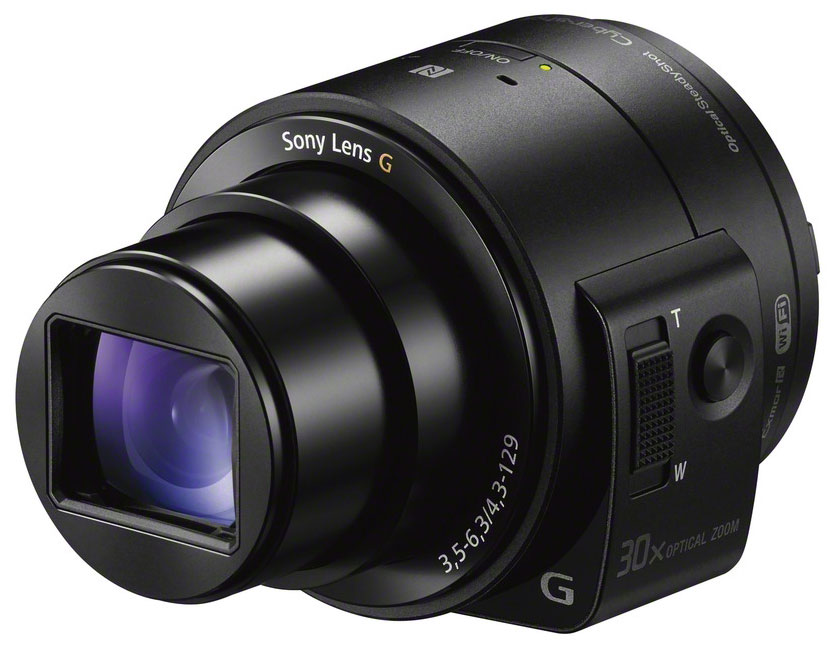
In late 2013, Sony revealed two new cameras unlike anything that had gone before. Both were completely reliant on a smartphone for framing, image review, and all control other than image capture and zoom. Of the pair, the Sony QX10 offered the more generous zoom reach, but at the expense of sensor size. Now, it follows up with the Sony QX30, a similar device whose zoom range is tripled -- but it's also quite a bit bulkier than the earlier model. At its launch last year, we noted that the Sony QX10 shared much with the existing Sony WX150 compact; now the QX30 follows in the footsteps of another point-and-shoot model -- this time, the HX50V.
And like the QX10 before it, the Sony QX30 packages its lens and sensor in a manner that feels rather bulkier than the standalone device, even if it's technically quite a bit smaller. Simplifying the comparison by considering the QX30 to be a perfect cylinder, and the HX50V to be a perfect cuboid, the lens-style camera is about one-quarter smaller than its more traditional sibling. The reason for the incongruity between real world and perception is quite simple: The traditional camera is slimmer on one axis once the lens is retracted into the body, where the lens-style camera is similarly-sized on all sides, making for a shape that's less pocket-friendly. Unless you're wearing a coat, you won't be slipping the QX30 in a pocket.
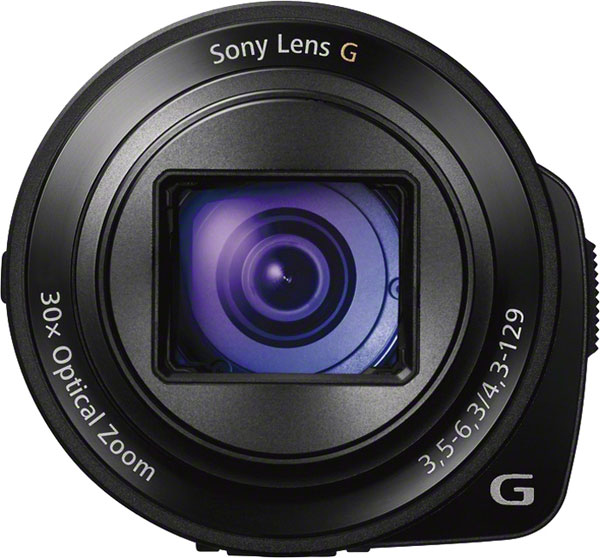
But be that as it may, the 20.4-megapixel, 30x zoom Sony QX30 does give you plenty of resolution and telephoto reach in a fairly small package. Maximum aperture varies from f/3.5 to f/6.3 across the 24-720mm equivalent zoom range, and maximum image dimensions are 5,184 x 3,888 pixels. ISO sensitivity ranges from 80 to 12,800 equivalents in Superior Auto mode or 80 to 3,200 equivalents in Intelligent Auto, Program, Aperture-priority, or Shutter-priority modes. Like the QX10 before it, the QX30 forgoes manual exposure -- a feature which is available on the HX50V -- in the name of simplicity. It does, however, allow continuous capture at 10 frames per second for 10 frames, just as does the HX50V.
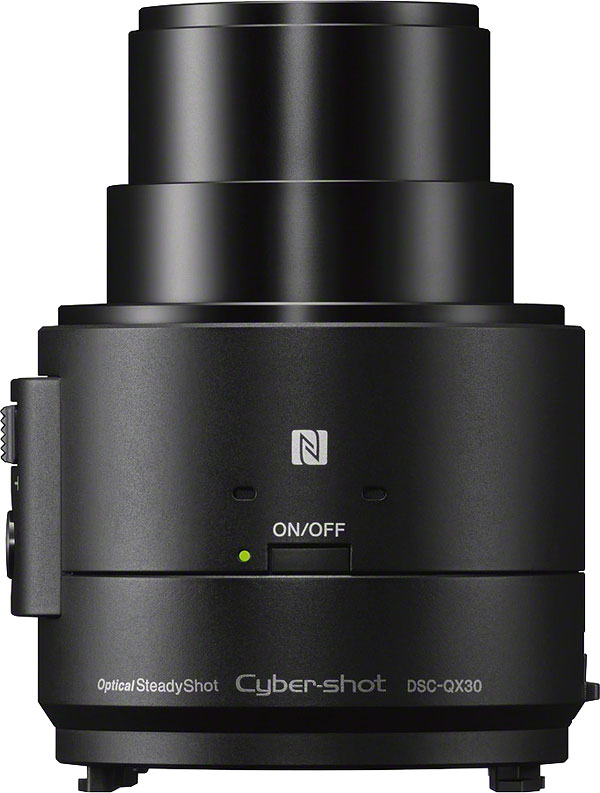
The Sony QX30 communicates with your phone via Wi-Fi, just as did the QX10, and also includes an NFC tag for quick and easy pairing with Android smartphones. The phone essentially serves as an interface instead of a built-in display on the camera itself, and the two can be attached via various optional brackets. (You can also use the device with a tablet, if you really want, but the ergonomics of that pairing may be rather less than optimal.) And physical controls are included for zoom and shutter button, so you can shoot standalone to the QX30's card slot, although you'll only be able to preview the image framing with your phone paired.
Movie capture is also possible at Full HD (1,920 x 1,080 pixel) resolution at up to 60fps with stereo audio, just as it is in the Sony HX50V, though only MP4 format is supported. The built-in GPS of the HX50V isn't included, though, so still image geotagging will instead rely on your smartphone for location information.
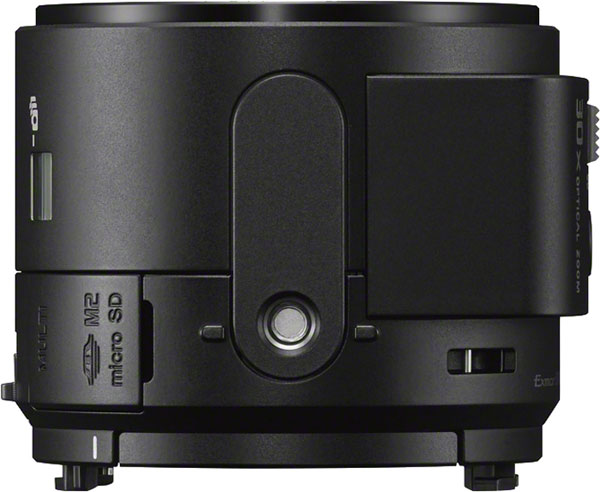
Connectivity options include the aforementioned Wi-Fi and NFC, as well as a single Micro USB port, which provides for USB 2.0 High Speed data connectivity, and in-camera battery charging.
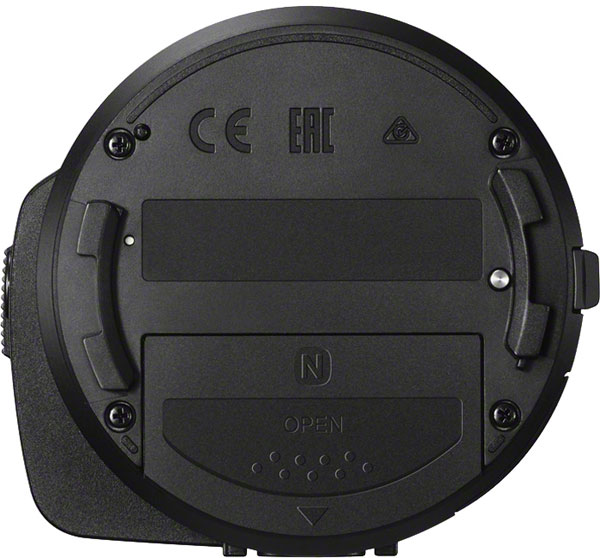
Power comes from an NP-BN/BN1 lithium-ion rechargeable battery pack, and battery life is rated at just 200 frames on a charge, despite the fact that there's no flash strobe. That's half the rating of the HX50V.The Sony QX30 includes a microSD / Memory Stick Micro slot. This is compatible with microSDHC and microSDXC cards too, as well as Memory Stick Micro Mark 2 cards. The QX30 also transfers images to your phone's storage as they're shot, so you can share them immediately or just keep them as a backup, until you run out of space.