-. Binding : Office Product
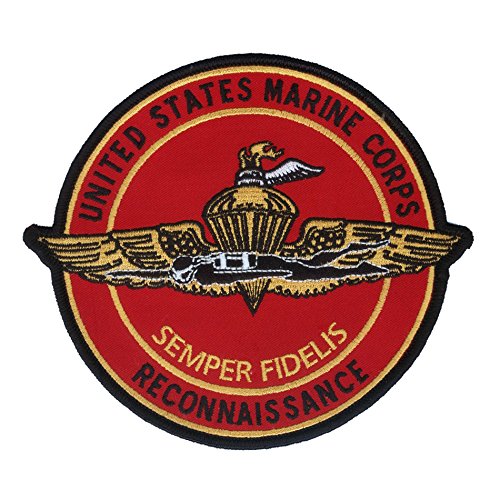
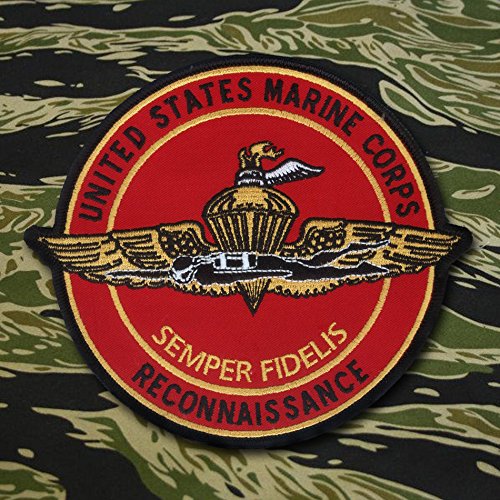
-. Feature : United States Marine Corps Reconnaissance Patch - Large 5 5/8" X 5" Highly Detailed Marine Recon Embroidered Patch - Semper Fidelis - MARSOC - USMC Reconnaissance -Camp Pendleton - Non-merrowed with a Wax Backing. / The Marine Recon we know today dates back to the W.W.II. Before 1944 the MR were P.R.Imarily scout/sniper units. In AP.R.Il 1944 a two company amphibious reconnaissance battalion were formed. They started operating with UDT (Underwater Demolition Team), to conduct beach reconnaissance and hydrographic survey. The MR along with UDT reconned for the landings at Iwo Jima in 1945. During the war in Korea the MR and UDT did a series of raids on Korea's east coast, destroying railroad tunnels and bridges. At a time the MR operated 200 miles behind enemy lines. In 1951 the MR made the first helicopter assault in the Marine Corps history. When the marines landed in Vietnam in 1965, the MR were there to support their respective Units. In Vietnam the MR conducted deep and distant reconnaissance patrols. They mostly operated in seven-man teams performing the so called 'Stingray' operations. The last marines left Vietnam in 1971. During the 1970s and 1980s the MR went through some changes. 23-man deep reconnaissance platoons were created to compensate for the seducement of the MR after the Vietnam War. The basic Recon teams were still the four-man teams. When the hostage recovery program was started in 1976 with federal law enforcement agencies and the Army Special Forces, some of the MR units were assigned to Direct Action missions. In 1977, snipers were again a part of the marine units. In October 1983 the MR took part in the invasion of Grenada, and in 1989 they went into Panama in Operation 'Just Cause'. In 1990 MR was deployed in the Gulf. Here they scouted the front lines of the Iraqi forces. They found ways through enemy lines for the marine invasion. P.R.Ior to the ground war the MR took 238 P.R.Isoners. / Marine Corps Force Reconnaissance was first conceived in 1954, at Marine Base Camp Pendleton, outside of San Diego, California, when an experimental recon team was formed. Three years later, that team merged with an existing amphibious reconnaissance company to form the 1st Force Reconnaissance Company. The precursor of Force Recon was from World War II, the Amphibious Reconnaissance Battalion commanded by Captain James L. Jones. In 1958, half the Marines in 1st Force were removed from the Company and hauled over to the Eastern seaboard, forming the 2nd Force Reconnaissance Company. 1st Force supplemented Fleet Marine Force Pacific (FMFPac), while 2nd, Fleet Marine Force Atlantic (FMFLant). Force Reconnaissance received their baptism by fire during the Vietnam War, arriving first in 1965 and staying for five years. Forty-four Marines of 1st Force were killed or missing in action through the course of the war. After US withdrawal from Vietnam, 1st Force and 3rd Force were both deactivated in 1974, and the existing Force Marines were rolled into the non-Force 2nd Reconnaissance Battalion in order to maintain Marine Corps deep recon capabilities. However, the roll-in was never completed to a satisfactory condition, and 1st Force Reconnaissance was reactivated as an individual unit in 1986, and was later deployed in the Gulf War. Many Force Recon Companies are in existence today, and have been deployed to both Iraq and Afghanistan. / Force Reconnaissance Companies are deployed within a type of larger Marine Corps units called a Marine Expeditionary Unit (Special Operations Capable) or MEU(SOC). MEU(SOC)s are deployed onboard Amphibious Ready Groups, a group of United States Navy ships. This group is usually centered around an amphibious assault helicopter carrier (designations for these ships range between LHA, LPH, LHD). There may be as many as three of these groups, with their attendant MEU(SOC)s, deployed around the world at any given time. The mobility and continual rotation of these formations is integral to current Marine Corps operating procedure, which sets a stated goal of being able to field a MEU(SOC) on any shore around the world within six hours of an order being given. There are currently seven MEU(SOC)s in the Corps. In MEF I WestPac, there are three MEUs: the 11th, 13th and 15th. They responsible for the Middle-East and the Persian Gulf region. In MEF II MedFloat, there are also three MEUs: the 22nd, 24th and 26th. They focus on countries around the Mediterranean Sea. The last MEF, MEF III, has only one MEU(SOC), based in Okinawa, Japan: the 31st MEU. As of 2004, there are currently four active Marine Force Reconnaissance companies: 1st Force Reconnaissance, based at Camp Pendleton, CA; 2nd Force Reconnaissance, based at Camp Lejeune, NC; 3rd Force Reconnaissance Company, based in Mobile, AL and 4th Force Reconnaissance Company, based in Honolulu, HI. 5th Force Reconnaissance was folded into non-Force 3rd Reconnaissance Battalion as Deep Reconnaissance Company, and is based with 31st MEU (SOC) at Okinawa.
-. Label : Bayonet Design
-. Manufacturer : Bayonet Design
-. PackageQuantity : 1
-. ProductGroup : Art and Craft Supply
-. ProductTypeName : ART_SUPPLIES
-. Publisher : Bayonet Design
-. Studio : Bayonet Design
-. Title : United States Marine Corps Reconnaissance Patch - Large 5 5/8" X 5" Highly Detailed Marine Recon Embroidered Patch - Semper Fidelis - MARSOC - USMC Reconnaissance -Camp Pendleton - Non-merrowed with a Wax Backing.