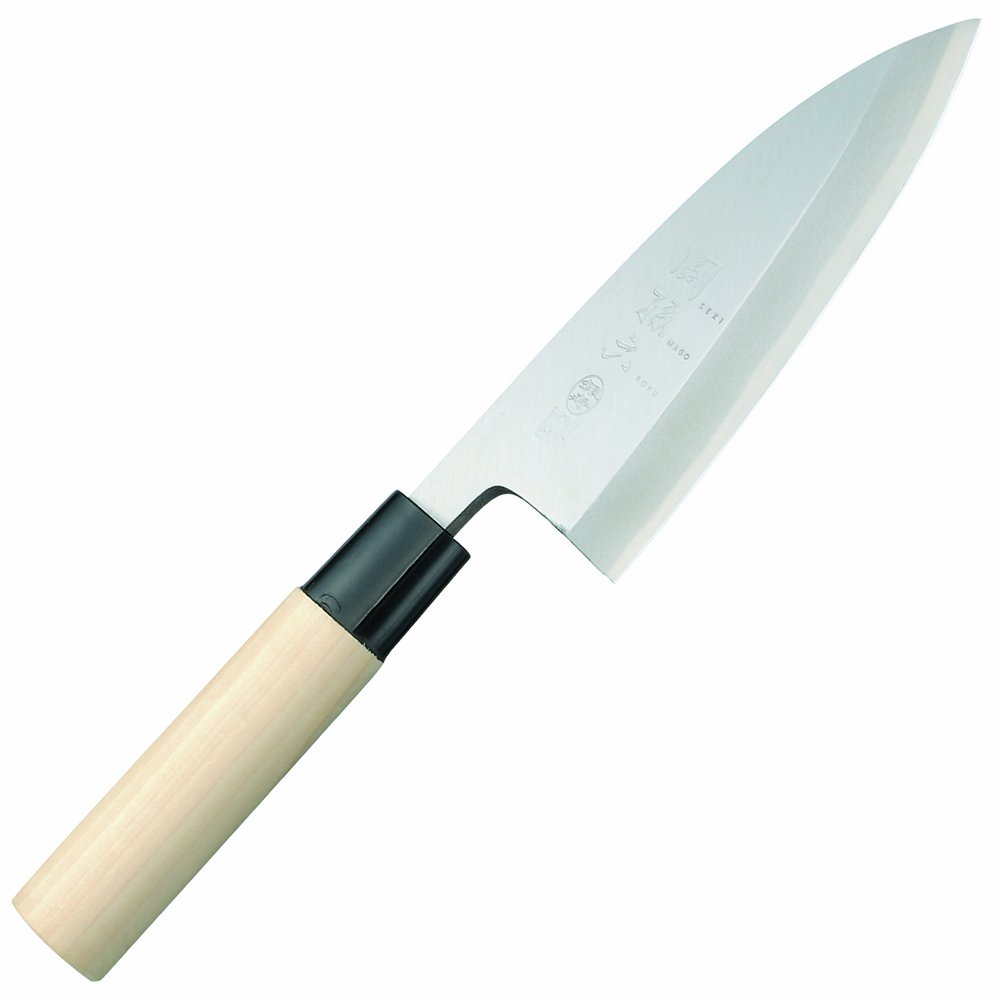
Item Descriptions:
From Amazon
Sharp main steel "forged Japanese-made"
A Japanese knife pursuing the sharpness suitable for the purpose of expressing the delicacy of Japanese cuisine by traditional forging manufacturing method combining steel and soft iron and sharp hand finishing blade
Convenient exit knife for fish and chicken judgment
It is used for judgment of fish, chicken, crab etc.
The thick part of the blade is used for knocking down each bone, the part with the sharp tip is used for wearing gently
Handle made from natural wood <Park>
The material of the handle has a sense of luxury, <Park> is hard to be damaged even if wet with water.
We are pursuing durability and ease of holding
made in Japan
How to Care
Even at the time of purchase immediate purchase, it will rust in 10 to 15 minutes if moisture, salinity etc. remain attached.
If you wipe off moisture and dry it, you can prevent rusting.
When not using for a long time, wrap it with newspaper impregnated with oil and keep it.
If it gets rusted, rust is dropped while sharpening with a grinding stone, or if it is a little rust, rust can be dropped by cleanser or "rust eraser"
Because it is made of steel (glasses), rust comes out, so it does not correspond to dishwasher and dish dryer
How to sharpen knives
1. Sharpen the table of blades.
Place the kitchen knife on the grindstone, hold it with your hands and adjust to the angle of the blade.
Keep one hand along the handle and keep the angle until sharp edges come out
2. Grind the back of the blade.
Place the kitchen knife flat on the grindstone and sharpen a few times until no blade returns without turning the angle as it is
How to sharpen an easy kitchen knife
When it does not break for a moment, slide both sides of the blade several times for threading of the bowl.
If it is still difficult to break, sharpen it several times with a simple type sharpener
Tradition inherited to Seki, the extremity of a sword
In the Kamakura period from the Kyushu to Seki (Mino), the swordsmith was blessed with good quality soil, water and charcoal, and the origin of Kurosushi started to make swords.
Many famous swords were born, but master craftsman Sekiroku Seki devised a unique sword and sent out the best work of beautiful artistic sharpness.
The period changed from Edo to Meiji era, many of the Seki 's swordsmen turned to manufacturing domestic knives.
The faith that Seki's sword was admired as "It will not break and break well," is well inherited to the modern knife making.
The inscription of "Sekiro Seki" is attributed to Mr. Kaneko Kaneko, 27th generation Kanemoto, by Mr. Kaneko Kaneko, utilizing the skill of the artisan, and conveying the sharpness to the present day
Sekiroku's Silver Lipo Steel Japanese Knife Series
Japanese kitchen knife series which forged eyeglass and soft iron by traditional manufacturing method, pursued a sharp sharpness and sharpening by full-scale cutting by hand finish
Blade: A kitchen knife that is active when fishing.
It can also be used for judgment of chicken, crab, etc.
Blade 105 mm AK-5015
Blade 135 mm AK-5016
Blade 150 mm AK-5017
Blade 150 mm (for left) AK - 5018
Blade 165 mm AK-5019
Blade 180 mm AK-5020
Sashimi: To be able to cut without delicate material, thin and narrow width and long blade length, draw from the blade edge to the cutting point at once
Sashimi 180 mm AK-5021
Sashimi 210 mm AK-5022
Sashimi 210 mm (for left) AK-5023
Sashimi 240 mm AK-5024
Vegetable cut: A kitchen knife exclusively for vegetables, with a thin blade, peeling and slicing, half-moon cutting in a round-cut knife
Rape cutting (west type) 165 mm AK-5025
Rape cutting (East type) 150 mm AK-5026
Thin Blade: A traditional shape that can be used for cooking mainly around vegetables.
You can finish vegetables delicately and delicately
Thin blade 165 mm AK-5027
Sailing: A kitchen knife whose name derives from the fact that the fisherman had cooked all the dishes with this kitchen knife on the boat.
It can also be used for small fish, shrimp, vegetables
Sailing 165 mm AK-5028
Sickle type: It is made with a single-edged blade, it is suitable for vegetable cooking such as peeling skin peeling, peeling and chamfering
Sickle type 165 mm AK-5029
Other Kai seal
Sekiroku Series here
Features:
- Manufacturer model number: AK-5016
- Size: 269 × 50 × 21 mm
- Weight: 180 g
- Material: Blade / Mating material (cutting edge / carbon steel, side gold / soft iron), base / nylon, handle / natural wood (Pak)
- Country of Origin: Japan
- Blade-over: 135 mm
- Specification: Nylon base
Product information:
Shipping Weight: 281 g
Package Dimensions: 2.59 x 8.20 x 40.01 cm
SHIPPING METHOD
Delivered directly from Japan by Japan Post. It will take 3 to 5 business days to prepare the order for shipping. We guarantee careful packing and safe shipping.Please note that in some cases additional import or VAT charges may incur and have to be borne by the client.
1. Japanpost registered mail
Shipment by Japanpost Registered Mail (Standard). Trackable any time with tracking number. Insurance is not available. Delivery time usually is between 1-3 weeks from the date of dispatch. Some items are not eligible for Standard Shipping.
2. Qxpress Standard
Shipment by Qxpress standard service. Trackable at any time with tracking number. Registered and insured up to a value of item price and shipping fees.Delivery time is usually between 5-10 business days from the date of dispatch.
3. EMS
Shipment by Expedited Mail Service. Trackable at any time with tracking number. Registered and insured up to a value of $200 and usually delivered in 2-6 business day from the date of dispatch.

| Japanpost registered mail | Qexpress | EMS | |
|---|---|---|---|
| Shipping Method | Japanpost Registered Mail (Standard) | Standard Qexpress | EMS (Expedited Mail Service) |
| Trackable | Yes | Yes | Yes |
| Insured | N/A | Yes (Up to item price and shipping fees) | Yes (Up to $200.00) |
| Asia | 1-3 weeks | 5-10 days | 2-5 days |
| Oceania; North America; Central America and the Middle East | 2-4 weeks | 6-14 days | 2-6 days |
| Europe | 2-4 weeks | 6-16 days | 3-8 days |
| South America and Africa | 2-4 weeks | 10-18 days | 4-8 days |
NOTICE:
- For overseas delivery, please be aware that damage to the outer box can be seen.
- If you would like to avoid as much damage as possible, please choose the EMS shipping method.
"According to Qoo10 guide line,overseas shipping fees will be charged to you extra if you choose Qxpress standard shipping.We recommend you to compare the total price of your purchase with EMS."
